FOR MEMORY, these memories have been dispersed into several chapters chronologically classified:
Vierville under occupation (0) The day before and before June 6th (1) The night of 5 to 6 June and the dawn of 6 June (2) At the same time, at the bus station of Vierville, at the Colibeufs (2bis) The morning of 6 June, from 6 a.m. to 12 noon (3) Afternoon and evening of June 6 (4) The morning of 7 June (5) At the bus station on June 7, at the Colibeufs (5b) The afternoon and evening of June 7 with the bombardment of the crossroads (6) On June 8, in the town of Vierville, with Captain Gardiner (of the Civil Affairs) (7) June 8 at Than Manor and Vaumicel (8) June 8 in Vacqueville (9) June 9 and subsequent days (10)
(According to other sources, the bombing of Maisy took place at 3:30 a.m.? Maybe two successive waves??)


(Night from 5 to 6 June)
"In order to enjoy the mildness of the temperature, after the usual work, my mother and I sat in the garden.
At approximately 2330 hours (on 5 June, but 0030 GMT+2, on 6 June, US time) I heard, between the low noise caused by distant explosions, the rumbling characteristic of the engines of the flying fortresses propagated by the sea breeze.
Then shortly before midnight it was the great fuss of the bombardment of Maisy, next to Grandcamp, but from Vierville we could not locate the exact place.
The Germans had lit their projectors and it was the first time I saw them. (There were DCA projectors at the Percée and St-Laurent)
In the bundles, small white dots similar to snowflakes could be seen, slowly descending, if distance were ignored. In reality, it was leaflets directing the coastal population to move immediately away from the coast, military operations being imminent. These leaflets were partly intended for us, it seems!!
At last, the noises gradually diminished in the sky as on earth and we went up into our rooms. I threw a look at the sea through the bay of the North facade through the corridor; the sea was a little clearer than the environment, the cliff ridge was clearly untied and, standing and still, the sentinel of the post recently installed by a detachment from the arrival division of the Eastern Front was cut off on the horizon.
There was always a distant ringing (probably the noise of the Force O boat engines that were beginning to arrive in their anchorage area 10 thousand off Vierville) and heavy explosions.
Somewhat reassured I lay on my bed without undressing completely, and fell asleep.
I was woken up at about three o'clock (i.e. 4:00 GMT+2 US time) by the noise of an aircraft engine going to amp quickly. The time to jump to the window at the same time as a whistle was heard and I saw the glow of two bombs exploding in cliff ridge on a plow belonging to my mother, 35 m away. to the right of the sentinel which had slightly curved its back and 200m. from our house. Six more bombs had fallen on the cliffside without causing any damage or casualties, except for turning the small vegetable garden of the villa "Les Fusains" into a huge funnel of sand.
Squeezing after these events I dressed completely, told my mother and the maid awakened by the explosions to do the same to be ready for any eventuality, and I went every quarter of an hour to my observation post.
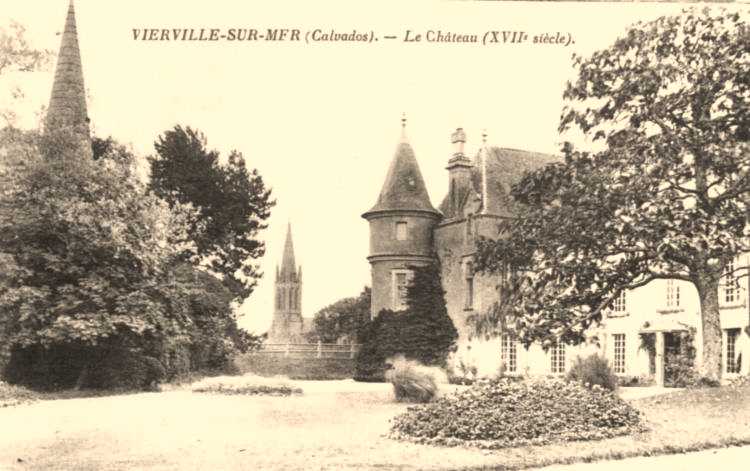
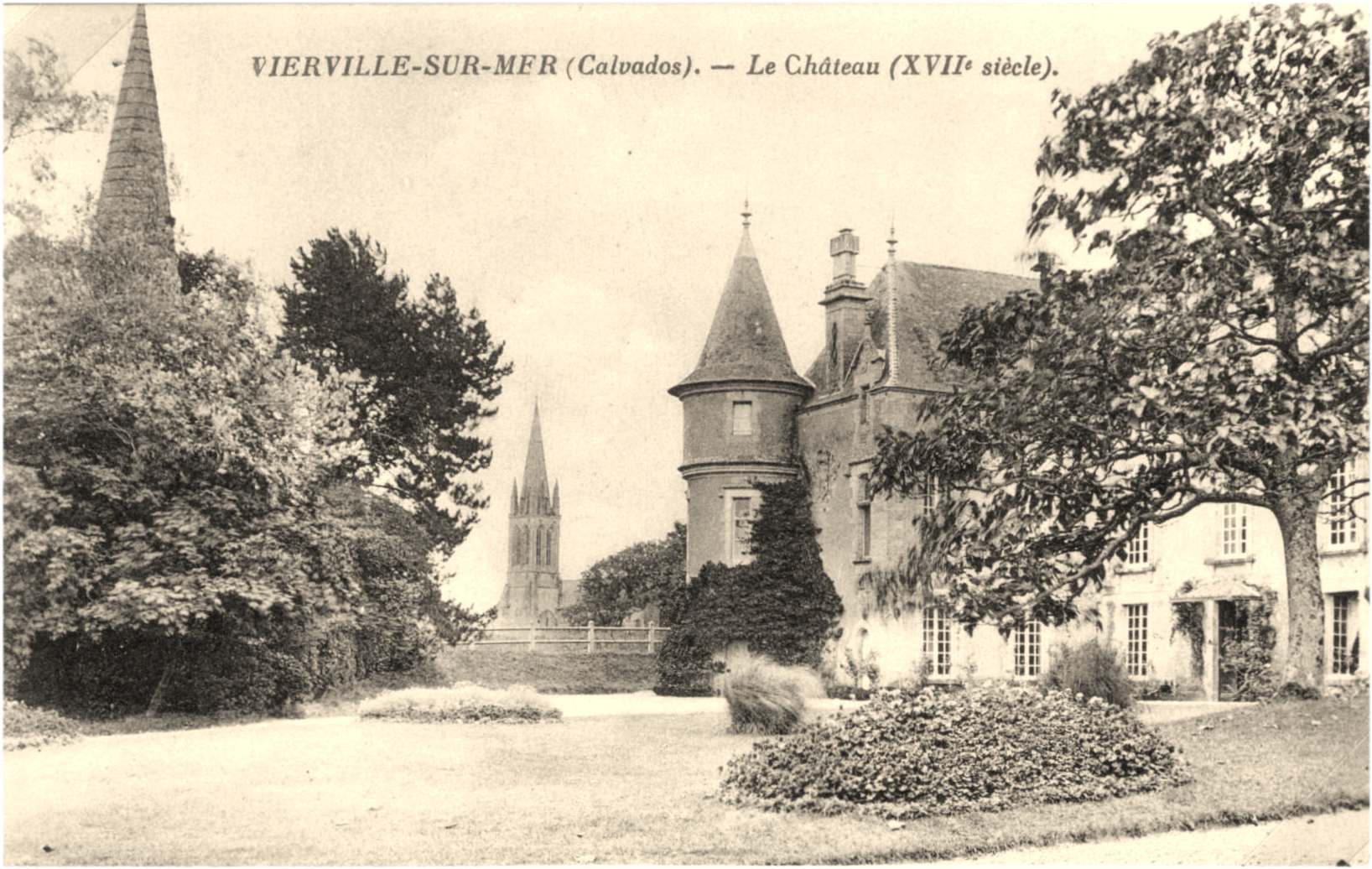
Below these 2 turrets in winter 1944/45, the turret of the Middle Ages was not rebuilt


But nothing happened abnormal until sunrise (the sky was largely covered, the sun was hardly to be visible that day, if not exceptionally, moreover it did not rise until about 6am GMT+2, after the beginning of the bombings) emerging from a strip of fog stagnating on the horizon, if not the deaf buzz (this deaf buzz was obviously the noise of the boats' machines, which is transmitted by water much more than by air and is thus understood to mean that Many nautical miles of distance) which was increasing.
And suddenly the mist curtain was torn apart at once and revealed thousands of boats: a superb and grand show.
I cried to my mother, "Look at the sea!" and passing through the window of the house and seeing my neighbour coming out of his house, I cried to him, "It's the landing, go see the sea and admire."
He passed through his vegetable garden, behind his house, accompanied by his wife, the cleaning next to his house and Huguette's parents did the same, they went up to the barbed wires limiting the so-called mined land and watched the show.
We were therefore all nine scorned and ecstatic by the painting that was available to us when the cart came drawn by a rapid Norman trotter and led, it seemed to us, by a German non-commissioned officer, bare head, open tunic and puffing shirt over his panties.
(this comic episode was told directly by MH to Cornelius RYAN who performed it in his book; and later filmmaker Darryl ZANUCK was inspired by RYAN; this resulted in more or less romantic narratives, MH tells here how he lived it exactly and his story is likely) The truth, here it is:
Every headquarters. armies had different intelligence at the dawn of June 6. Some of the parachuting in the Cotentin and east of Orne was beginning to be held, but between these two regions what was going on? Pluskat (the actual presence of Major Pluskat in his artillery observatory in Sainte Honorine - according to RYAN - was strongly contested by Germans in his unit; in any event, there was surely one official in the observatory able to telephone what he saw) had just warned his chief of corps at the moment that an innumerable fleet was ravaging him, but each corps commander demanded their unit leaders placed on the confirmation coast and additional information.
Thus a non-commissioned officer of the company stationed in the area and belonging to the 352nd Division had been ordered to go to the cliff of Vierville and to account for what he saw. This order had reached the captain (commanding the 11th company, the Than mansion) in hierarchical order from the division general.
This soldier who was used to waking up or waking up his men by the classic joke "Up, the Tommies are coming" made sure that the order came from his captain, quickly dressed himself, borrowed the cart of the coffee carrier and headed towards Vierville, at the small trot. He passed the grocery store, the rue du Hamel at the priest for 50 m. and turned left in the meadow where the breach was in the barbed wire network. This field went up slightly towards the overhanging path leading to the post (the WN70) located above my villa and, as it was bordered by tall grasses, one could only see the sea by crossing it.
Arriving at this place the man rose, saw the Allied fleet, raised his arms in the sky, jumped from the cart and sprinted towards the post held by his men.
The horse turned around and took his stable back to the great trot, feeling that the fire was going to start when the boats were close, everyone took his home, and my mother took her jewels and her money and went to the shelter.I joined her with a chair and before going down the six steps I laid down through the trench about ten fagots that were nearby.
Barely arrived in the shelter, the fire started.
It was just over 5:30, English time.
(Naval shots started at exactly 5h50, GMT+2 American time, and so 10min before sunrise)
(It is difficult to know surely what these shots, directed mainly at the coastal defences, were able to reach in the village itself. About certainly it was at this time, 06:00 in the morning, that the following buildings were hit, by medium-calibre shells (Vierville was targeted at at this time by destroyers and by the medium artillery of the battleship "Texas", i.e. the calibre 127mm):
- The rear wall of the mayor's house in the village
- The gable of the Jean house, on Pavée Street
- the bakery of Pavée Street, (2 dead, Jacques LEROUX, 10 months, son of the baker, and Pauline BERNASCONI, 20, employed by the baker)
- The old isolated turret in the castle park
- A second floor skylight on the façade of the castle
- The roof of the corner turret of the castle, crossed by a shell
On the other hand, it is likely that all the buildings neighbouring the church were hit during the bombardment of the bell tower around 14:15 on June 6, including the church itself, the presbytery, the house Collières, the small house in front of the posterior entrance of the Than mansion. As for the damage on the crossroads, post office, school, Pignolet hotel, bus station, etc., they date from 7 June at 8 pm, los from the bombing by the Germans of the crossroads.)