Memories of Michel Hardelay (10)
June 9 and the following days in Vierville
FOR MEMORY, these memories have been dispersed into several chapters chronologically classified:
Vierville under occupation (0)
The day before and before June 6th (1)
The night of 5 to 6 June and the dawn of 6 June (2)
At the same time, at the bus station of Vierville, at the Colibeufs (2bis)
The morning of 6 June, from 6 a.m. to 12 noon (3)
Afternoon and evening of June 6 (4)
The morning of 7 June (5)
At the bus station on June 7, at the Colibeufs (5b)
In the afternoon and evening of 7 June with the bombardment of the crossroads (6)
On June 8, in the town of Vierville, with Captain Gardiner (of the Civil Affairs) (7)
June 8 at Than Manor and Vaumicel (8)
June 8 in Vacqueville (9)
June 9 and subsequent days (10)

drawing up on the basis of
indications by Michel Hardelay
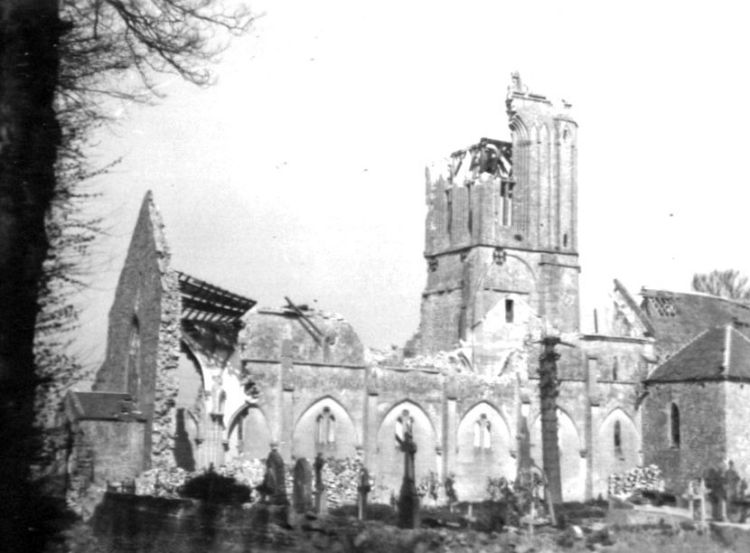
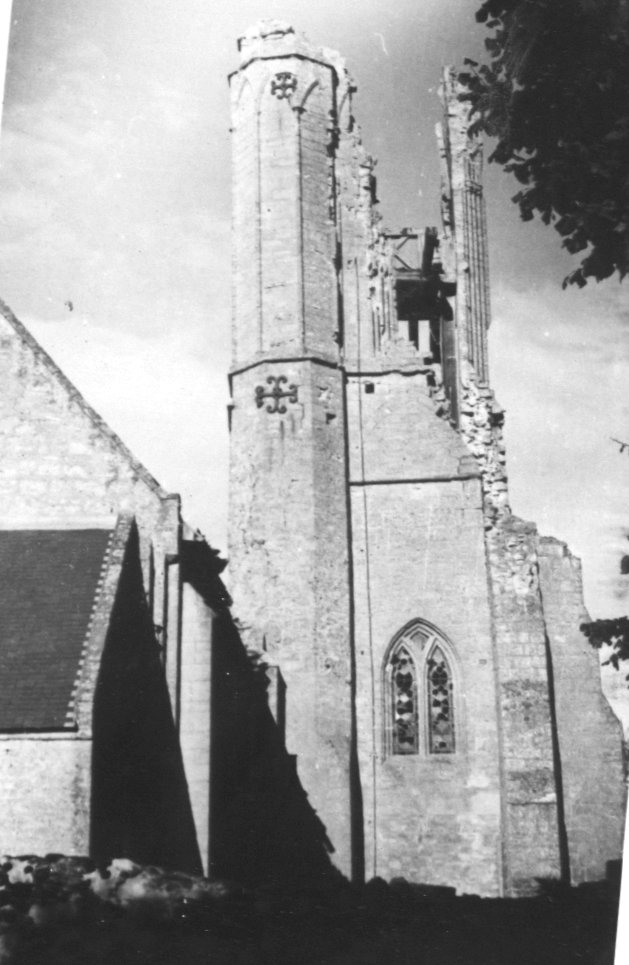
On June 9, a German in the bell tower
"Nearly after the end of our lunch we heard the bom-bom near a heavy machine gun. I put on my bike and went to see what was going on.
The fosseur was digging a grave for the post office's husband, who was to be brought back in the late afternoon when a bullet whistled to his ears and came crashing on the bottom of the almost finished grave. According to the impact the blow could only come from the top of the staircase of the bell tower. Father Helen, who did not want this grave to be his, came out of the hole of a leap and warned the Americans.
They sent a half-track to the scene, and the half-track fired (to the heavy machine gun 12.7mm) through the fine murderers illuminating the stairs. I was assured that then a black man had climbed into the tower ... and had killed or finished the German who had to be there since Wednesday night (June 7), having come with the enemy counter-attack and being responsible for informing his own about the movements of the U.S. units.
But it was not the last German to hide in the commune. On July 6, a German who was tired of waiting for the return of his family and who had also finished the provisions amassed in his cache came out of it, located in the current campground and went to a black man handling a balloon."
And this is the story of Cannoner Allen Levin, 116th Infantry Regiment, Cannon Company, who also dealt with the church sniper:
"We were finally able to join the Cannon Company in Vierville-sur-Mer at D+3.(9 June).Vierville is a small village built around a square. The Cannon Company had settled on a plot next to this square. In the middle of the square, there was a church with a bell tower. There was a lot on each side, the Cannon Company was on one side and on the other there was a water pump. When one of us wanted to get water, a sniper in the bell tower was shooting at it. None of us were hit when I heard about him. I went on the road and tried to see where the shot came from. Lieutenant Hill of 115th AntiTank arrived with a jeep, asked me what the problem was. He tells me to give him one of our rifles throwing grenades. He threw a grenade through the slits of the bell tower without touching the sides. When the grenade exploded, the men entered the church to see if the sniper had been killed. They found a wine locker in the church and stopped their search. On that day, we did not know the fate of the sniper, but the men were happy. "
Visit of 2 American officers:
"One day, around noon, we had the visit of two U.S. officers. who weary of eating the same eternal preserves asked us if we could cook them two steaks they had bought. Of course they had lunch with us, and the fries accompanied the meat. They did not speak French but I managed to understand that they were the ones who had been responsible for preparing the detailed maps of the landing on Omaha-Beach and that they were concerned about two issues.
They believed that the path of the little tortard still existed because it was clearly visible in the aerial photos.
They had studied the movement of sand banks on the beach but had found no valid rules.
On this last point I tell them that there were none and that their movement depended on the storms and was therefore unpredictable."
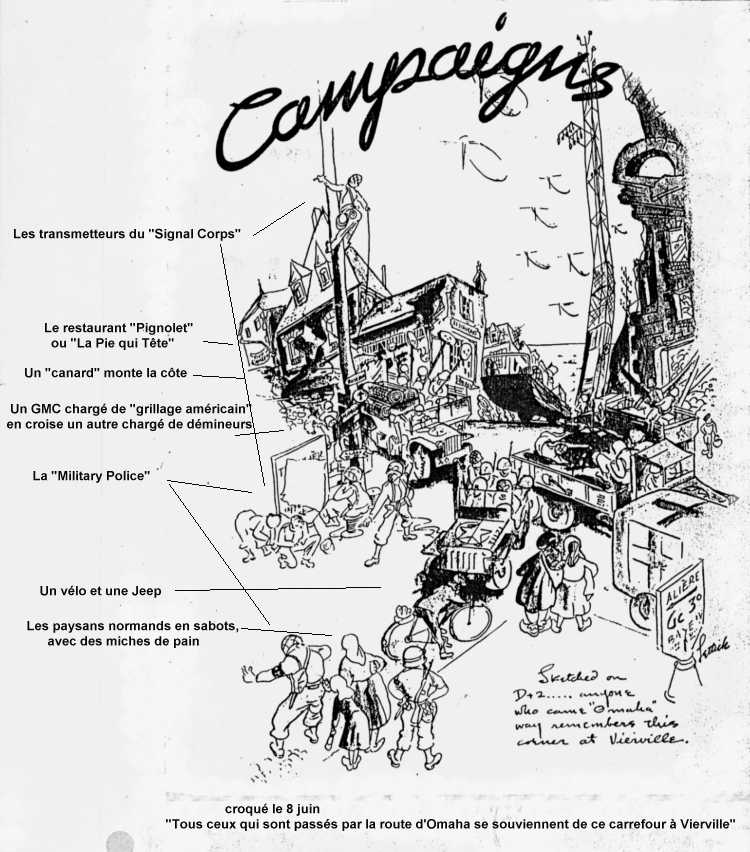
The MPs (the "Military Police", with white striped helmets)
"They had their post in a small building, old butcher shop, without a facade wall and without a roof, - they had made one with makeshift materials - two of them were bikers accustomed to very large leather belts.
In addition to the military police missions, their work was to regulate traffic at the crossing of the post and, in particular, to whistle at trucks that lost a box by passing through the hole caused by a shell fired at the crossroads on 7 June; but not any box, for when it was a wanted product (cigarettes, chocolate, etc.) they kept it for themselves in order to barter (with civilians)
When there were convoys they regulated traffic and indicated to the leading drivers their routes and places of camp, "areas" designated by short words, Able for A, Baker, Charlie, Dog, Easy, etc. One day I remember counting I counted 110 vehicles in a minute!
But some days it was much quieter and they sometimes put the youngest (Paulette) of the daughters of Father Louis (Colibeuf) in a faction with helmet and white stick in the middle of the crossroads and sat in their small. A general had come by, stopped to look at this new recruit and pushed a huge burst of laughter.


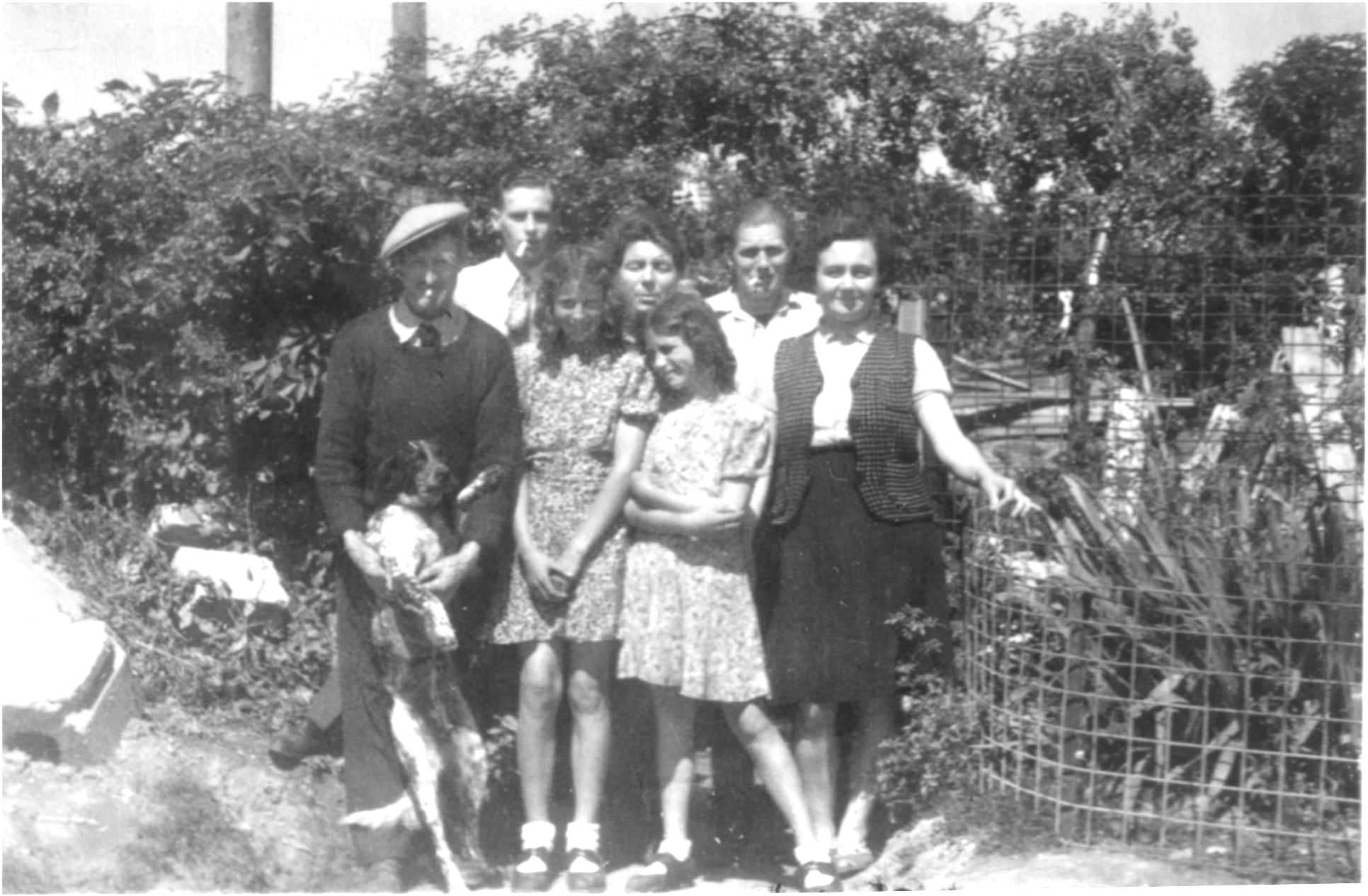
I was gonna find them if I found an abandoned weapon. So the postwoman, returning to see what was left of her, that is, a few meters of vegetable garden, discovered a rifle in her salads.
I had warned the M.P., but they had just received a memo warning them that the Germans had taken the habit of trapping the most diverse objects (door slit, toilet chain, well rope, etc.) by withdrawing.
I proposed to them to shoot the gun from behind a wall with a rope with a hook. Of course nothing happened, but the rifle was loaded, it was to be the one of the young German taken prisoner in front of us on June 7 at 5 p.m."
Traffic
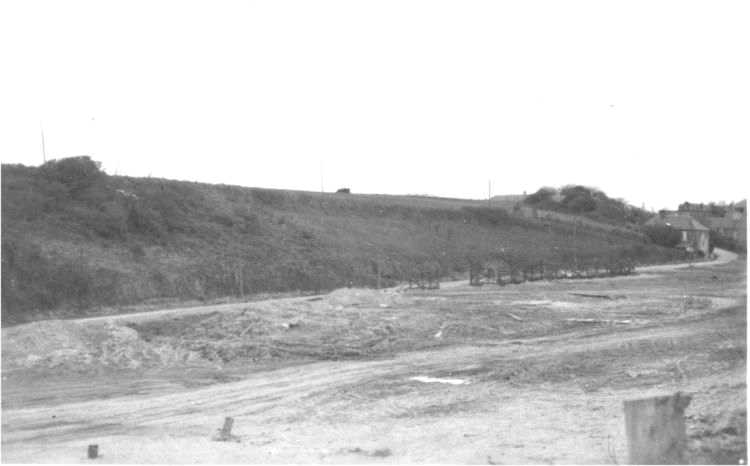
"The trucks and the armoured vehicles took the road on the side of the valley (through the field facing the castle), as soon as it was finished; the armoured vehicles had a special route which passed along the park of the castle (by the field of the Bricsart, east of the castle? or along the "Fosse Gras, west of the castle?", passed along the enclosure of the Vaumicel, then the old Green Way, to get lost in the bottoms of Veret.
The U.S. engineers. had created a huge by-pass to avoid the intersection of Formigny. He was leaving from the bottom of Capet Street to make a large circle that led to the church."
The risks of mines
"One day, as we finished lunch, my mother saw the partition of the room behind my back, taking off from the ceiling and leaning dangerously, and then returning to her normal place at the same time as a violent explosion was heard.
It was a GMC that blew up an anti-tank mine on the new road, but it was following other trucks that had passed safely. I don't know if it was a mine forgotten by Noël DUBE (a sergeant of the engineering), responsible for the clearance of this herbage; but when I arrived there, the truck was the wheels in the air and the driver killed at his wheel was released.
The accident had happened in front of the house Le Bastard, the last house intact in the rue de la Mer; it was occupied at that time by an old lady, pretending to be young because celebrating her birthday every 4 years (she was born on February 29), at which one came to get her ration of tobacco, with tickets (it was the tobacco office of the village, the house still exists).