Memories of Michel Hardelay (3)
arrival of the first G.I. at Vierville around 9:20 a.m.
FOR MEMORY, these memories have been dispersed into several chapters chronologically classified:
Vierville under occupation (0)
The day before and before June 6th (1)
The night of 5 to 6 June and the dawn of 6 June (2)
At the same time, at the bus station of Vierville, at the Colibeufs (2bis)
The morning of 6 June, from 6 a.m. to 12 noon (3)
Afternoon and evening of June 6 (4)
The morning of 7 June (5)
At the bus station on June 7, at the Colibeufs (5b)
The afternoon and evening of June 7 with the bombardment of the crossroads (6)
On June 8, in the town of Vierville, with Captain Gardiner (of the Civil Affairs) (7)
June 8 at Than Manor and Vaumicel (8)
June 8 in Vacqueville (9)
June 9 and subsequent days (10)

(details)
the house where Michel Hardelay lived on 6 June, at the bottom of a north-facing impasse


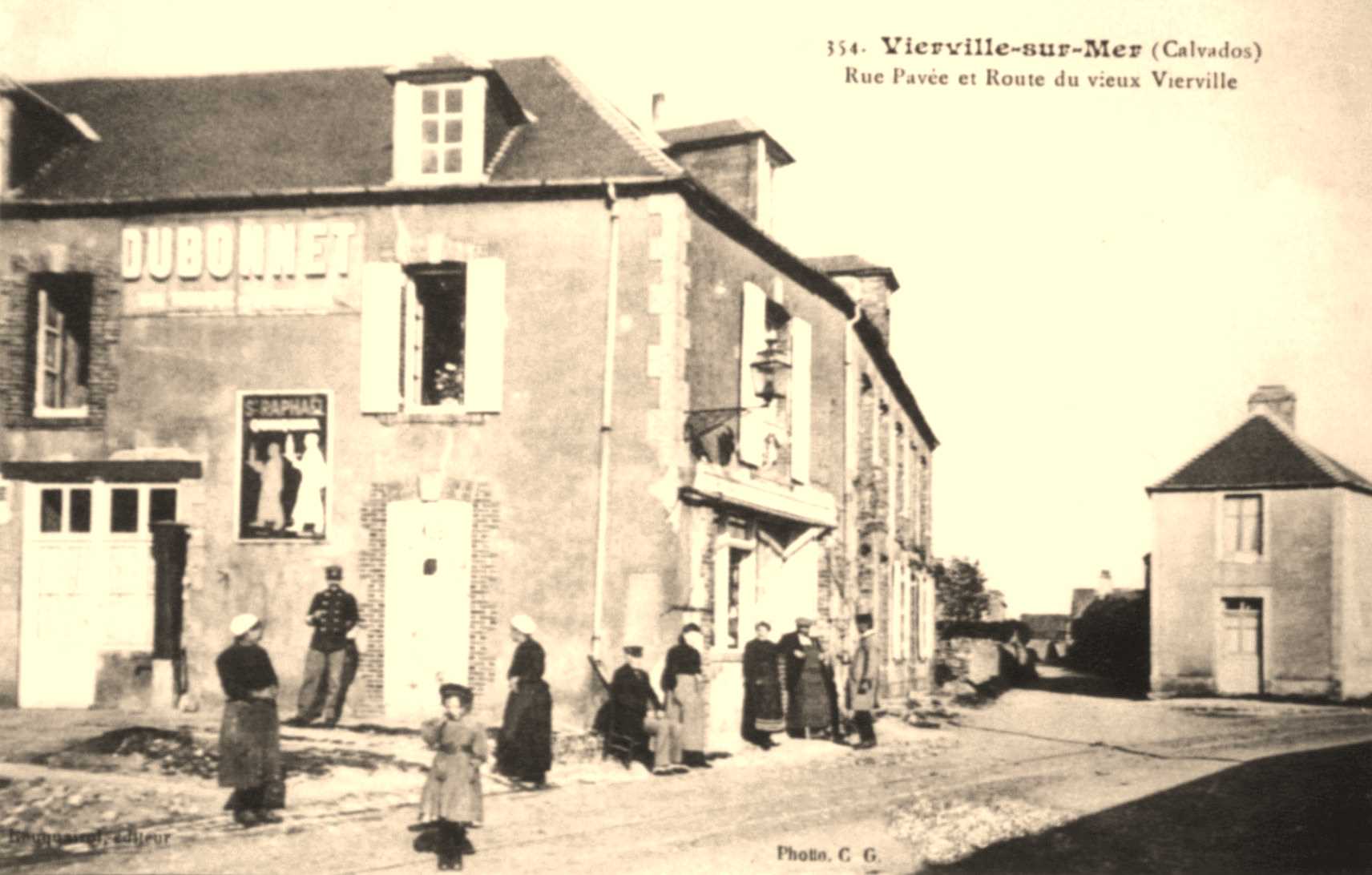


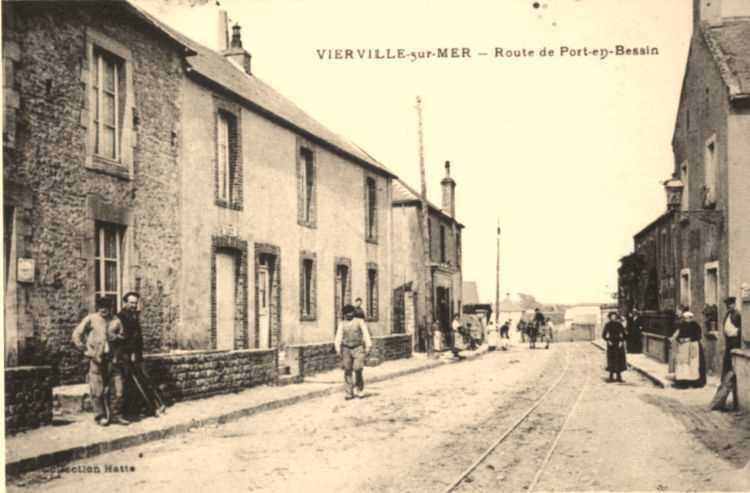
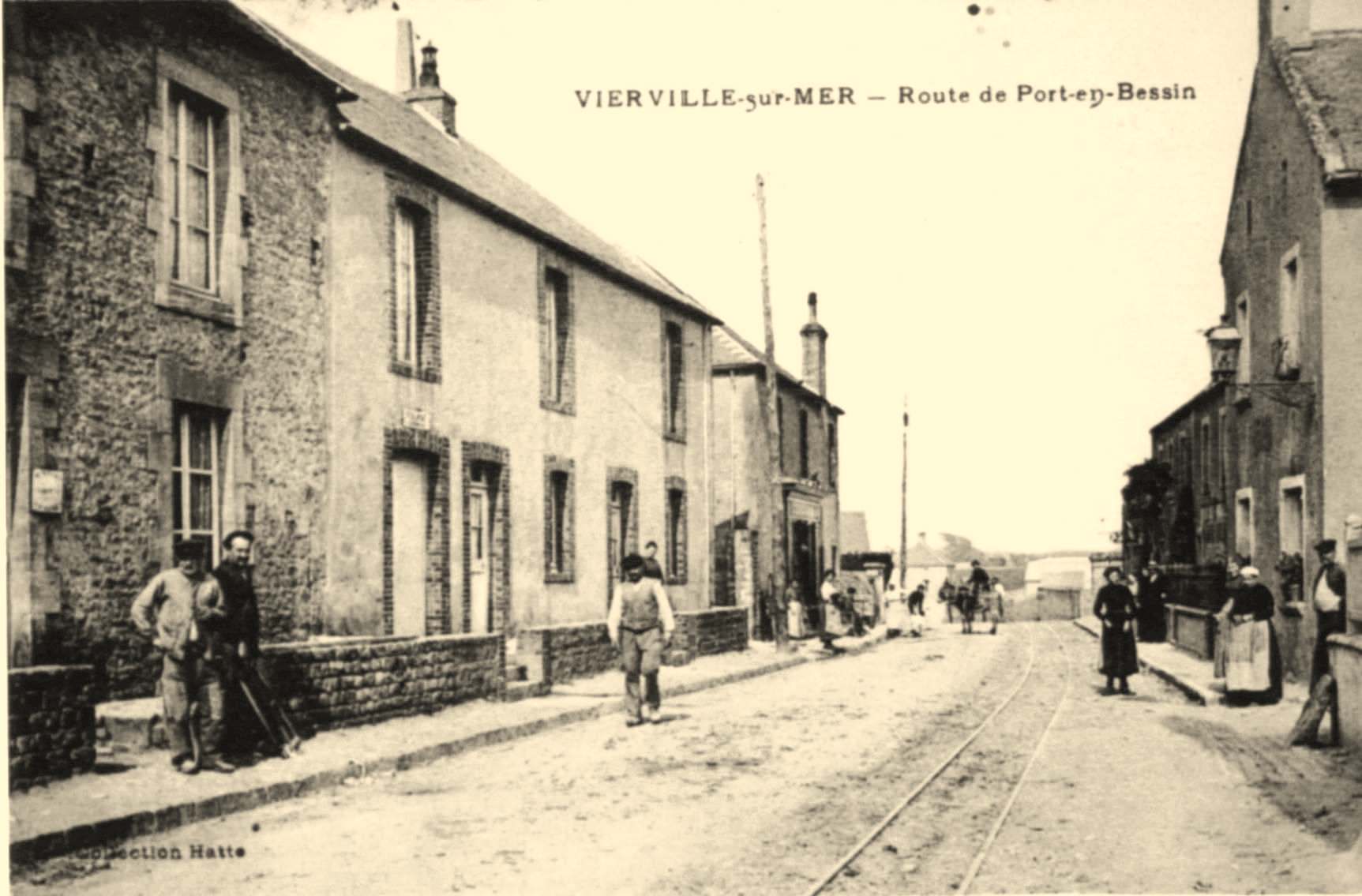
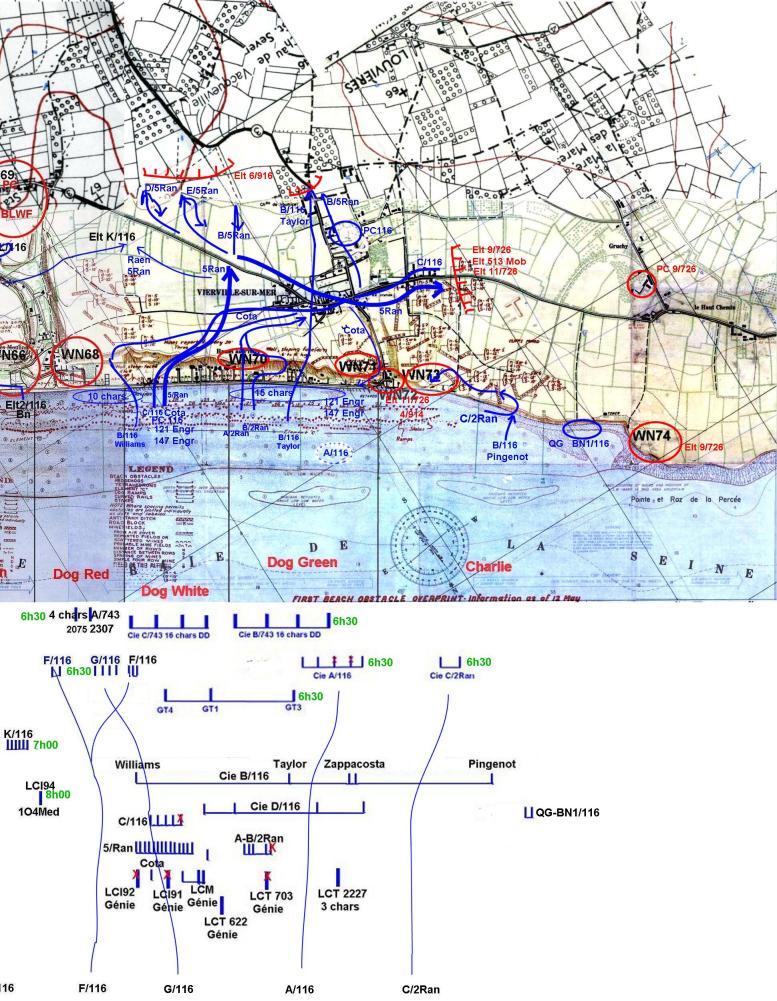

(extracts) (6 June, from 6 a.m. to 10 a.m.)
"It was eight hours minus ten (8h50 GMT+2 time used by the Americans on June 6) and it was two and a half hours ago that, under the vault formed above our heads by the projectiles of the Allied fleet and German artillery, we waited for the firing of the guns and mortars to cease.
Suddenly a tremendous deflagration deafens me and my mother. It was followed by a powerful breath mixed with dust and a strong smell of powder.
The explosion took place behind the fence wall of the garden, which was three metres from our shelter trench and which was supported by a few rabbit niches.
I could see some of them, frightened, running in every direction, while others had almost buried themselves in their litter at a corner of their niche.
I moved a little out of our shelter and found with great relief that our house was still standing; at the same time I felt a burn, at the auricular of the right hand leaning on the wall of the trench. Examining the freshly cut earth I could extract a small piece of steel, burning and sharp, from the size of a cherry core.
The fuss had suddenly ceased as if this last explosion were an organ point in the artillery concert.
Our eardrums, put to the test, did not start functioning until after two minutes to hear a few bullets whistle before losing themselves in nature or crashing against a wall.
Oh! how much on that day I blessed the presence of these many walls which also served to protect against the northeastern wind of winter, icy and salty, so harmful to plantations. They allowed me to move with relative security around our shelter, lowering my head because most of them didn't exceed 1.50 meters.
By the opening left free at the end of the draft trench I soon saw two German soldiers passing, curving their heads, holding with one hand their Mauser, on the other a box of bullets.
They crossed our little garden and engaged in the passage, between the house and the high wall of our neighbour as if they knew this path leading to the countryside and the cliffs, passing through the henhouse.
I made the decision to get out of the shelter to check that they had closed the doors well, entered the house through the kitchen door five meters from our shelter, found that there was no significant and visible damage except that, having climbed to the first floor, no arrow at the church bell tower, (the memory of MH it trompe, because the bell tower was only shot down at around 14:15) and by the bay overlooking the cliffs I saw my two Germans walking towards the post of the 352nd D.I., newly installed on cliff ridge. They were almost four-legged in the wheat field, already very ripe, and were almost invisible.
For our poultry, nothing to fear, because frightened like rabbits, they had hidden themselves at the bottom of their cabin.
When I leaned over, I saw that the back wall of the neighbour's house (the mayor's house, Mr. Leterrier) had collapsed in his yard.
In front of me the sea was covered with boats of all dimensions but the ridge of the cliff hid the beach and I could only observe beyond three kilometers in front of Vierville, as I distinguished the piers of Port-en-Bessin in front of which no significant activity seemed to manifest itself.
On the other hand, he seemed to me to perceive a line of warships in front of the tip of Ver to my right and also to my left in the bay of Veys.
But what troops would free us, English, Americans, Canadians or French?
For now it was a mystery.
On the other hand, the Germans who were still firing in cliff ridges had to know who they had to do.
At that moment I didn't expect that in five minutes I would be informed.
The shooting seemed to be over, and I decided to go 30 metres into the main street of the village; I went out of our garden and crossed the alley along the facades of the two nearby houses to the left, empty of their occupants, and then the side façade of the grocery store (to his left, the Dumont grocery store, at the crossroads of the rue du Hamel-au-Prêtre) and stopped one metre from the street.
From there I could observe to my right the street for two hundred meters: in front of the house of the shoemaker two dead horses, the legs tangled in their harness and the draw of a forage of the army, [according to some testimonies, it was that of the company of workers Todt housed in the castle since the beginning of March 44, this testimony says that it was in front of the "infirmary", perhaps a German infirmary in the village??] filled with canteens, crates and ballots.
They barred part of the road, the other half being obstructed by the collapsed gable of the house Jean.
No soldier was in sight until the crossing of the post.
I then went forward to observe on my left the two roads that came to meet in front of the grocery store.
A big guy was standing in front of me. He was trying to pull out from one of the many and vast pockets of his battle-dress a bundle of "Chesterfield" rather creaked.
"Do you want a cigarette?" he asked in French.
He had his helmet a little inclined to the left, the two straps of the jugular, unattached, hung along his cheeks, his rifle was at the shoulder strap on his left shoulder.
He didn't seem surprised at my appearance, observed the two dead horses with the appearance of a tourist rather than of a watchman.
I replied, "With pleasure," and then added, "Get it! Do you speak French?"
"I am a Canadian-born "ranger", but my parents live in France, in the Eure, in Nonancourt. Excuse me, I have to continue on my way." And he set out a step towards Pointe du Hoc, which was the purpose of his mission, as I learned later. I go back to our shelter and say, by showing my cigarette,
"It's the Americans who free us"
I was looking at my watch, but it stopped walking and stopped at eight o'clock minus ten (8.50 GMT+2), probably as a result of the dust blow.
It was now to be eight hours twenty" (i.e. 9:20 GMT+2, at the time used by the Americans)
Then Michel Hardelay makes sure his neighbors are safe,
"I left them a little reassured and went back in the opposite direction...
When I came to our garden I heard screams in the street. Having won my observation post at the corner of the grocery store I live two G.I. which forced, under threat of their weapons, two Germans to rip off the road the two dead horses and place them in a courtyard entrance. They had a great deal of difficulty in carrying out this task and were not reassured about their fate so much the excitement of the G.I. was big.
A little later, two other American soldiers came to the garden door and made me realize that they were thirsty. I went to get two glasses and told them, by showing the barrel, that I had only "cider" or "apple juice" to offer them. This seemed to them equal; I filled the two glasses by turning the singing and tending them. But they demanded that I drink a sip before them and I executed myself. They had to become much less suspicious later.
Shortly afterwards I was surprised to see Fernand D's face appear over the wall. We sometimes called her more familiarly between us "the rupee" because he constantly had a drop in his nose and wiped it off the back of his left sleeve. He cared about our fate, went to the mayor's house and took the path I had followed.
He lived in the house in front of which the two horses had been killed and told me about the fate of his own and his neighbors: his wife and daughter were well, his mother who lived in the house opposite his, too, but the baker's maid had been killed and the baker's baby she held in her arms.
My mother's old friend, in the nearby house, had taken refuge with her faithful maid, and like Anne-Marie, in their toilet, fortunately because a 88-mm shell had crossed their house without exploding.
Madame Marie, who was staying with her husband and her son in the property Jean, had been injured in her arm.
Then, but I don't remember what time of day, an officer came with two soldiers, without weapons and without equipment, and told me they had been "shocked". He asked me if he could entrust them to me for an hour, but I accepted it and showed him that there was little room in the shelter. They sat down on the access steps; they were little locacious and I could just know that they were from Texas.
The officer was correct, after an hour he came to take them back, but how did he know that the house was still occupied and that there was a shelter? Mystery.
At the time of the BBC's French news broadcast, I had not failed to come up and listen to my station at galena. It was confirmed to me that it was indeed the expected landing, from the Cotentin to the mouth of the Orne, and not a commando operation, as in Dieppe (in 1942).