JUNE 6, 1944 VIEWED BY ENGLESQUEVILLE-PERCEE
(extract from " The Renaissance of Bessin " )
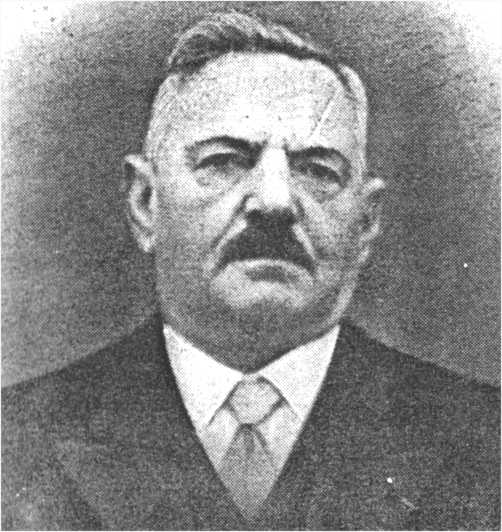
The testimony at the heart of the event of Charles Lepelletier, mayor of the time (Charles Lepelletier was mayor of Englesqueville-la-Percée for about twenty years until 1957, year of his death)
The subsequent operations of the Landing are now well known. But to add to it the testimonies of personal adventures lived in these difficult days now seems to be the important work of memory. Today, as a contribution to this task, we deliver the unpublished account of Charles Lepelletier, mayor of Englesqueville-la-Percée at that time. This document (thanks to Henri Lepelletier, mayor of Englesqueville until March last, who kindly entrusted us with the written testimony of his father) was written shortly after the events. It is therefore normal to feel, mainly in its construction, a series of striking emotions, impressions and images.
There was a semaphore at the Percée that the Germans had occupied since August 1940. Soon, they installed various tracking and radio devices. At the end of 43 and the first months of 44, important work was carried out to protect and ensure the operation of these devices. Powerful blockhouses and several barracks house the 150 specialized men, consisting of sailors or soldiers who are part of the aviation and DCA."
"(...) A right road recently built descends on the road from Grandcamp to Port-en-Bessin. It is of perfect visibility. It will guide the English aviation that occurs at eight o'clock in the morning on 24 May. Twelve aircraft, for forty minutes, without respite, attack in all directions, with machine guns, guns and bombs. For the Germans it is safe-who-may-general."
"( ... ) A pioneer company, whose headquarters are in the vicinity of the church, during this time hastened the population to plantation of stakes in the herbage. This work is not moving forward."


"( ... ) The carelessness and inertia of Englesqueville's farmers and workers are clearly visible. They draw the mayor's attention. The German command spoke to him about sanctions, he was told, the most late commune. However, this state of affairs continues. The days pass. Tuesday, June 6, it's a terrible night, night of horror spent under the constant bombing of the aviation and the uninterrupted tremor of the explosion of bombs on the enemy positions of neighbouring communes. At the point of day, shells fell on Vierville. It's 5 o'clock (probably GMT+1 time, it's 6 o'clock for Americans) we have explosions on the road and in the grasses. It's a bad time. A worker's house is gone. The communes of the farm Saint-Hilaire are affected. Some 60 planes drop their bombs in the hamlet of the Lightnings. We're occupying makeshift shelters, hiding in the ditches. The "Boches" are on the lookout. Two Germans arrive by bicycle and ask me for men, horses and cars to carry ammunition from Englesqueville to La Cambe. At this point, the bombardment increases in intensity. I drive them, they disappear."
"About 8:00 am (9am for the Americans), calm seems to be coming back. We wonder what's going on. From a nearby farm, I discover the black sea of boats. They're here, under Vierville and close to the cliff. The doubt is no longer possible: it is landing."
"(... ) In the afternoon, I decided to go and get bread in Vierville, I had to go down a bike several times. The road is punctured with shell holes in various places in the avenue of Louvières Castle (Gruchy). Five or six Germans who seem cautiously watching the direction of Vierville, let me pass. 300 meters further, I see soldiers lying on each other on the right berm. At their height, from the slope, a man makes me sign to approach him. I am led to a drinking pot and I find myself among a hundred soldiers camouflaged with foliage. In bad French, I am asked a few questions which, I do not understand. I wonder what all this means. Worried, I examine the feet of these soldiers and see that they are not wearing boots, a good surprise (the wearing of boots was the own of the German army). I've known since he was a captain. When he saw my astonishment, he said to me, "Americans! Landing Troop." I don't believe it. On the road I had just left, I greeted the first two American soldiers I saw, who had fallen for our deliverance."
I then make the decision to return to Englesqueville by small paths leading to Louvières, as soon as possible to announce the good news. Some Boches are prisoners near the school (the one of Vierville). In front of the train station (Vierville), an American forbids me to continue on my way. He's making me lie down in the ditch. I'm getting the first pack of cigarettes. After half an hour of waiting, the troupe set off and I set foot in front of the town hall, between two soldiers, I entered the little path of the church of Louvières. I find myself in the midst of soldiers with a remarkable bite, not caring for me. I'm continuing my path with branches cut off by the Navy's rocket shells. I note that he had been the scene of a real carnage. On the right, in a herbage, a whole cow is killed. Finally, after passing the second small crossroads by a hundred meters, the Americans seriously explore the terrain. I'm approaching three Americans. The blood's still flowing, it's fresh. I only have five or six soldiers in front of me. The first two talk to each other and then come back to those who are near me. I pass before them, so I do, in a vacuum, about 200 m, when I see on the slope, on the left, a German who asks me a question. I signal to him that I don't understand and continue my journey. I'm finally on the road to Asnières. I go back on my bicycle and quickly head to this village whose entrance was violently bombed. I finally get to Englesqueville. "
"(...) Back home, I announce the good news to my people. Two young people in class 42 that I've been hiding for a year seem incredulous. But I can quickly convince them by offering them the first American cigarettes."
" (...) It is seventeen o'clock. During my absence, two Germans, in Englesqueville for many months, came to inspect my farm twice. In the afternoon, at 5.30 p.m., they blew up their recently established radio station in the village. They're leaving by way of the way to the Fox. For us, it was over. We only had to see prisoners. "