the 3 beach areas of Vierville:
Charlie, Dog White and Dog Green
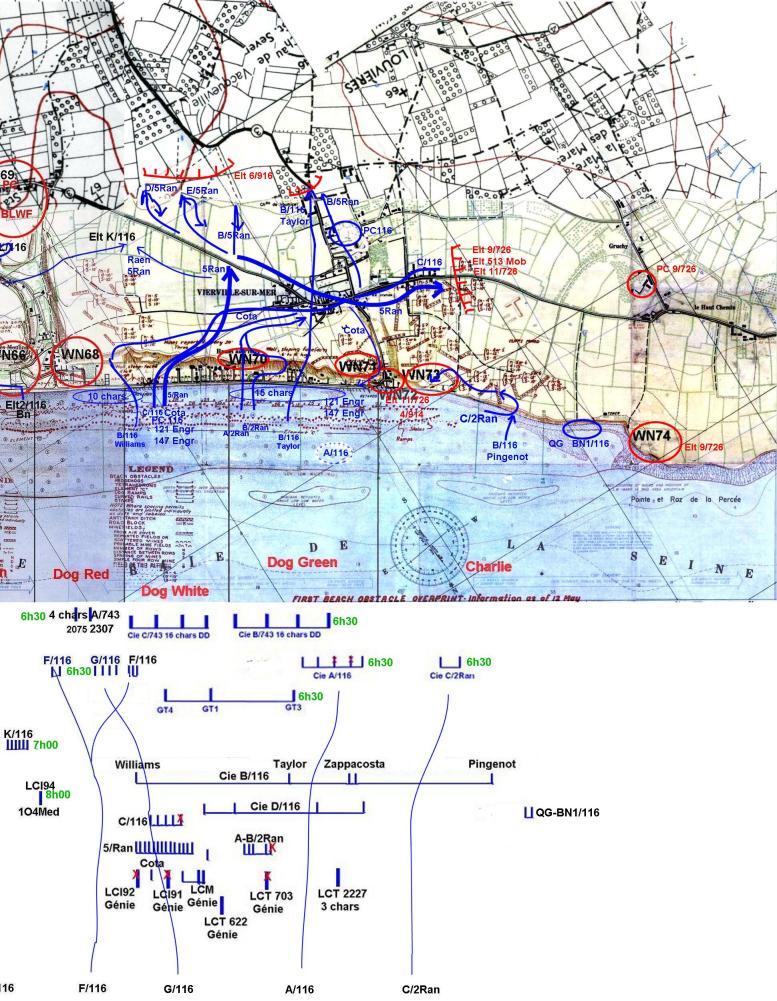

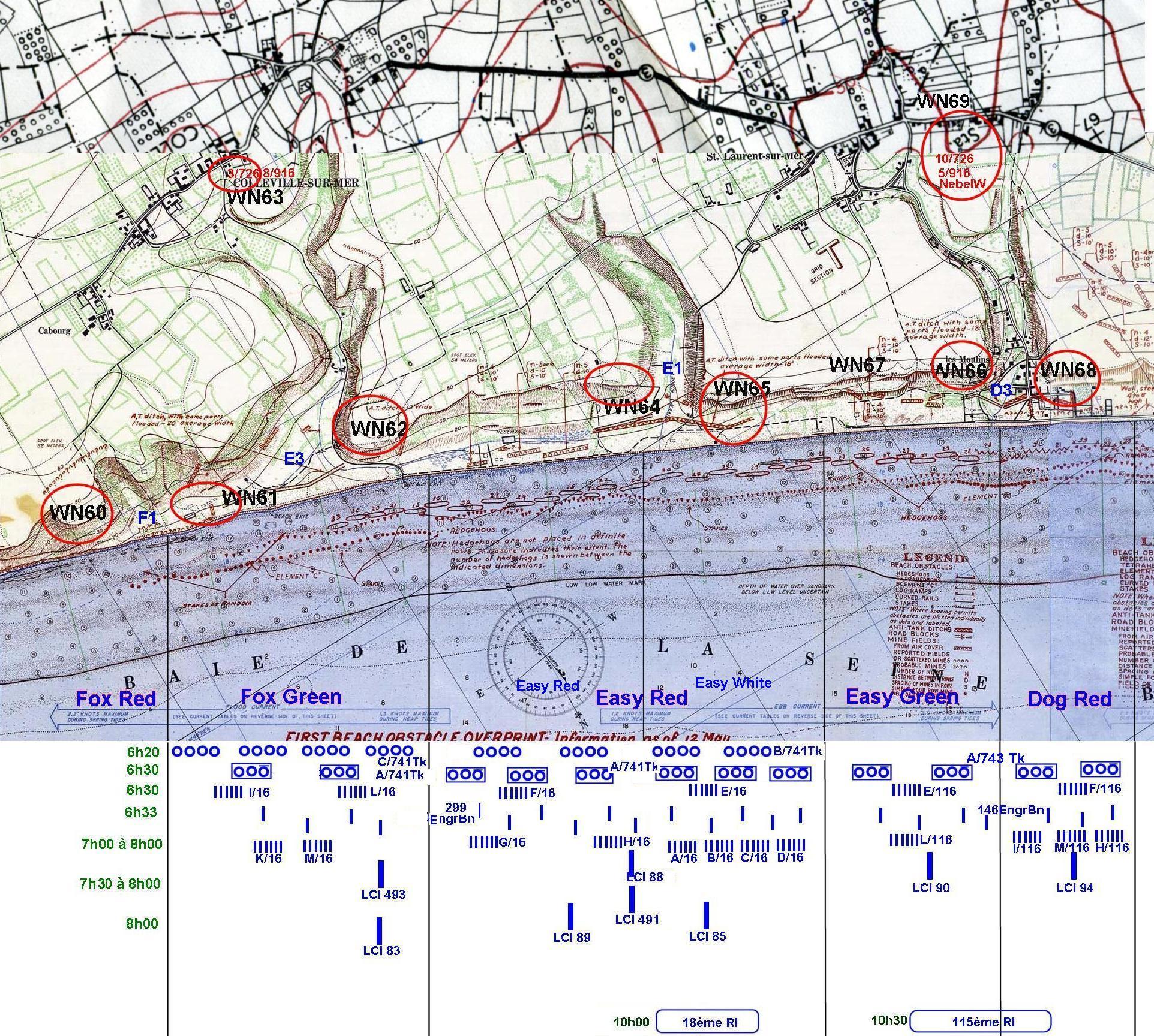

Details of scheduled landings in Vierville (Charlie, Dog Green and Dog White) between 6:30 and 10:00
The Forecast chart of landings specifies the staggering of the waves of assault:
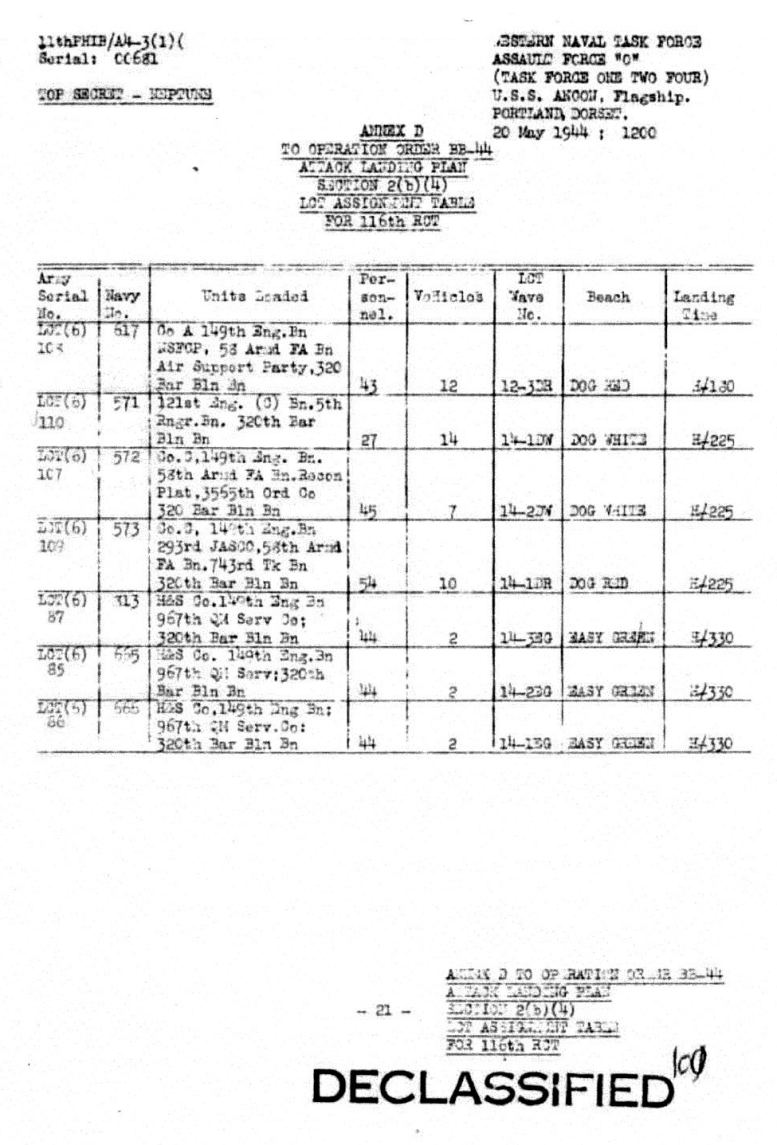
The loading table gives the distribution of units in the different ships for the entire Vierville zon on June 6.
At 0625 (H-5), the 32 amphibious tanks of the companies B and C (Sherman DD tanks) of the 743° Tank Battalion were to touch ground on Dog White and Dog Green.
At 0630 hours (H), 8 standard Sherman tanks (1/2 Cie A/743) were to arrive on 4 LCT and reinforce them. These LCTs were also required to land 4 Tankdozers to assist SETF engineers.
The amphibious tanks were expected to be launched at 6,000 metres from the shore, hit land and take their firing positions by the water to cover the first phase of the attack. Their fire was to be directed at the main enemy fortifications, especially those in the Vierville Valley and those in the Percaea, which could shoot flanks at Dog sectors.
Advancing among the obstacles at the same time as the tide, all tanks were then to support the main attack and exit the beach by St-Laurent. These tanks were attached to 116° Reg. to ensure close coordination with the infantry attack.
At 0631 (H+1), the first wave of assault infantry was to hit land with 2 companies, each aboard six LCVP (Landing Craft Vehicle and Personnel) or LCA (Landing Craft Assault). The companies were organized into 6 sections of boat replacing the 4 classic sections.
Company A/116 was to land on Dog Green, at the head of the attack on exit D-1 (Vierville) by 1st Battalion (1/116).
Company G/116 was assigned to Dog White. This force was to cross the discovering beach among the obstacles and immediately attack the WN70 strongpoint over the villa "Hardelay".
The infantry attack, supported by tank fire, was to attract the attention of German strong points and thus cover the demolition of the beach obstacles by the Special Engineer Task Force.


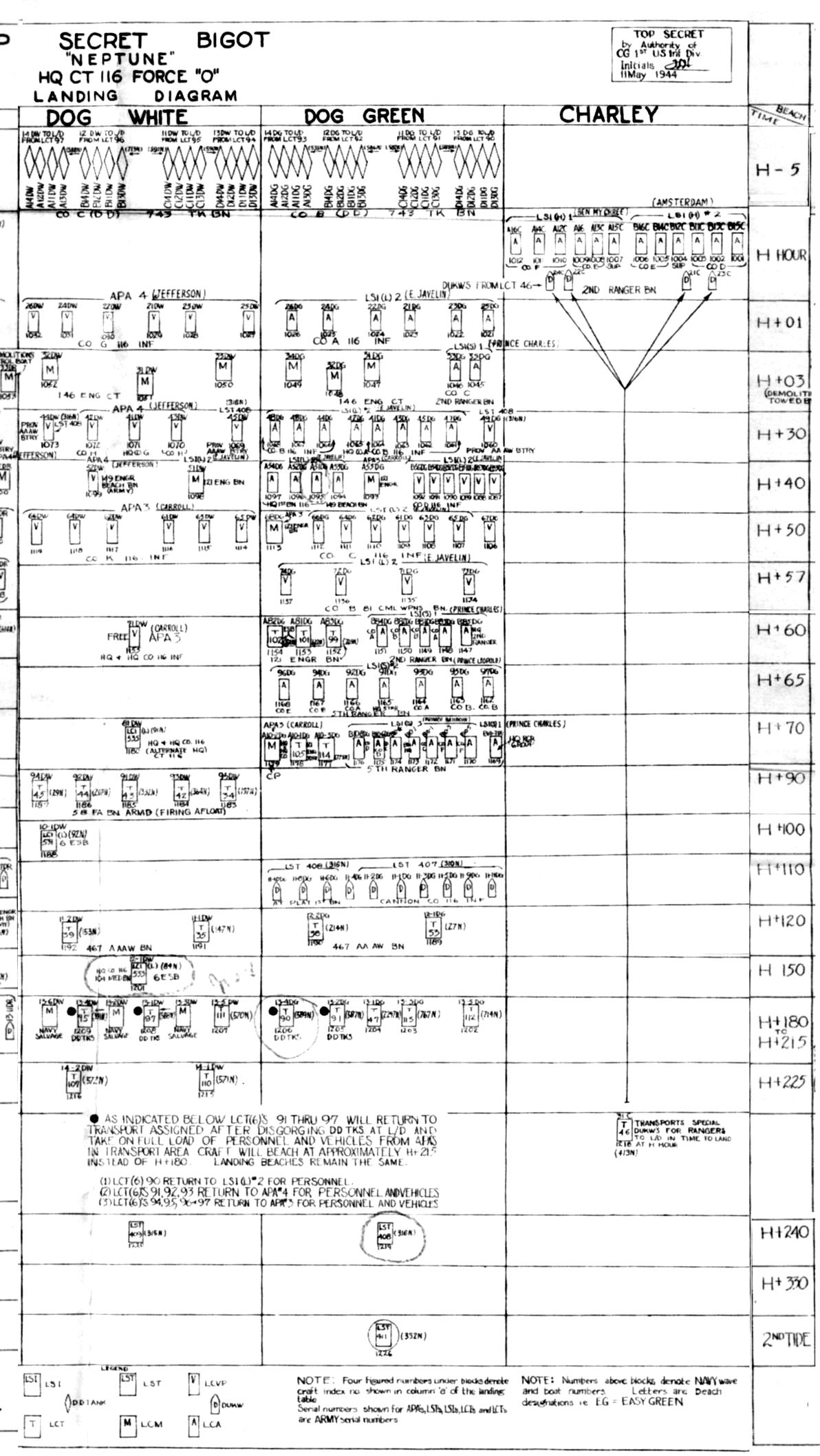
For example you will find the loading table of Force O HQ, planned to land on the Ruquet, in Laurent Lefebvre's book "They were at Omaha Beach" edition of 2003
You will also find the correspondence table between the loading lots and the numbers of ships assigned in Laurent Lefebvre's book "They were at Omaha Beach" edition of 2003

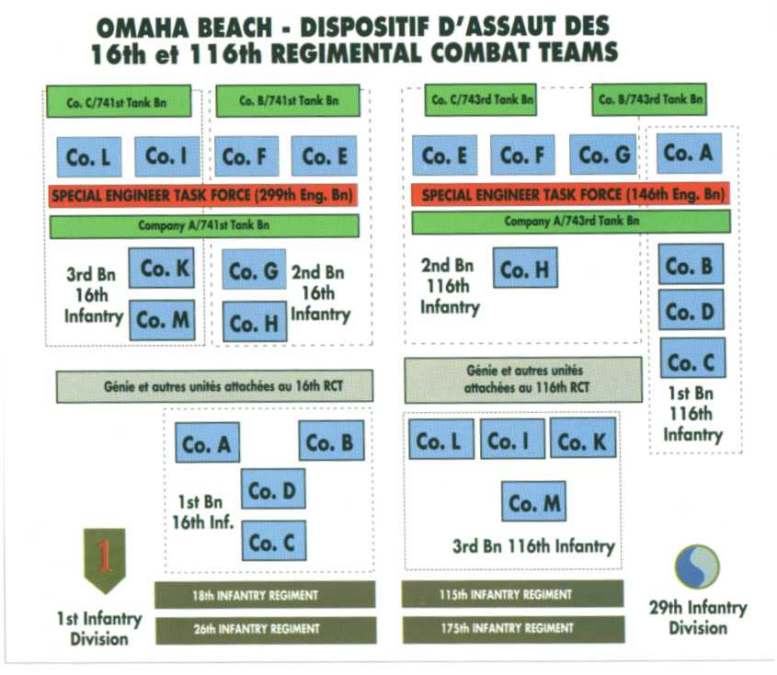


From 0633 to 0638 (H+3 to H+8, the "SETF", Joint Special Force Engineering + Marine, was to arrive) in 6 LCM (Landing Craft Mechanized). These 6 teams, each of an average of 43 men, included a naval demolition group with 1 officer and 12 sailors. The troops of the army were composed of 4 assault teams and 2 support teams, from 146°Batillon du Génie.
They had a vital mission to accomplish: disembarking as the sea discovered the obstacles, they had to open and mark corridors through these beach obstacles so that the barges could then reach the shore at high tide without difficulty.
On Dog Green and Dog White, they had to prepare 4 holes 50m wide (two breaches per sector). The 4 tanks-dozers landed at 6:30 am of 4 LCT were to be used to push, demolish and pull these obstacles out of the bottom of the beach. Explosives were to be used on others, and deminers would remove mines on obstacles or in sand (if found).
A period of 30 minutes was reserved without further landing to allow the work of these specialized sappers and sailors.
From 0700 (H+30), the second wave of assault would arrive at the shore in 5 successive landings.
On Dog Green, they would bring the remaining units of the 1st Battalion of 116th Reg: the B/116 and C/116 companies and the CieD/116 heavy weapons (80mm mortars and 12.7mm heavy machine guns).
On Dog White, they would bring:
- elements of the 2nd and 3rd Battalions of the 116th Reg.
- the headquarters of the 116th Regiment
- a company of the 81° mortar battalion (heavy 120mm mortars.)
- elements of the 121° engineers Combat Battalion. The mission of the second Engineer contingent was to assist the assault infantry in crossing the minefields and obstacles and to open the beach exits for the passage of the vehicles from 9.30 a.m. (H + 3 hours). He was then to accompany the 1st Battalion of the 116th Reg.
- advanced elements of a third engineering force were also to participate in this second series of landings. This force was part of the 6th Special Engineer Brigade organized into three battalions, the 147th Beach Engineer Battalion to land in Vierville (on Dog Green and Dog White). They were to help clean the beach of mines and obstacles and open the exits.
Then, when the elements of the 121st Engineer's Battalion would advance inward with the infantry, the Engineers of the 147th Battalion would assume sole responsibility for the organization, operation and maintenance of the landing facilities in Vierville and the depots in the interior.
Between 0800 and 0830 hours (H+90 and H+120), the first artillery units were to arrive, conducted at 0800 hours by 5 LCT carrying the 16 self-propelled 105mm artillery howitzers of the 58th Field Artillery Battalion, which had taken part in the preparatory bombardment by firing from the LCT.
At 8:20 a.m. (H+110), 10 DUKW ("ducks") were to bring the 75mm and 57mm anti-tank gun companies. attached to the 1st Bat of 116° Reg..
At 8:30 a.m., 4 LCTs were to land the Half Track DCAs armed with 12.7mm multiple wares. 467° anti-aircraft artillery battalion.
At 0900 hours of the elements of the 104° Medical Battalion was to arrive on Dog White.
At 9:30 am (H+180) the bulk of the vehicles and supply had to start disembarking, in increasing quantities. (Some vehicles were included in the second wave)
Around 10:30 am (H+240), there were to be cranes, tank troubleshooters, halftracks and trucks of all kinds all over the beach. From then on, the shuttle boats (barges "Rhinoferry" and LCT) and the "decks" were to play the greatest role in the transport of vehicles and supplies.
At 9:45am (H+195) The most important reinforcements of the assault force were to begin their landings, with the 115th Infantry Regiment of the 29th Division on Dog White and Dog Red (St-Laurent).