Navy Fire Control Groups
NSFCP (Navy Shore Fire Control Party)
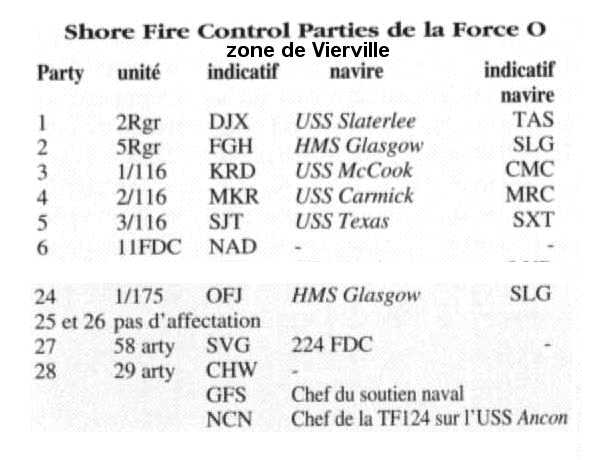
List of NSFCPs in Vierville, with their assignment unit and associated fire support vessel.
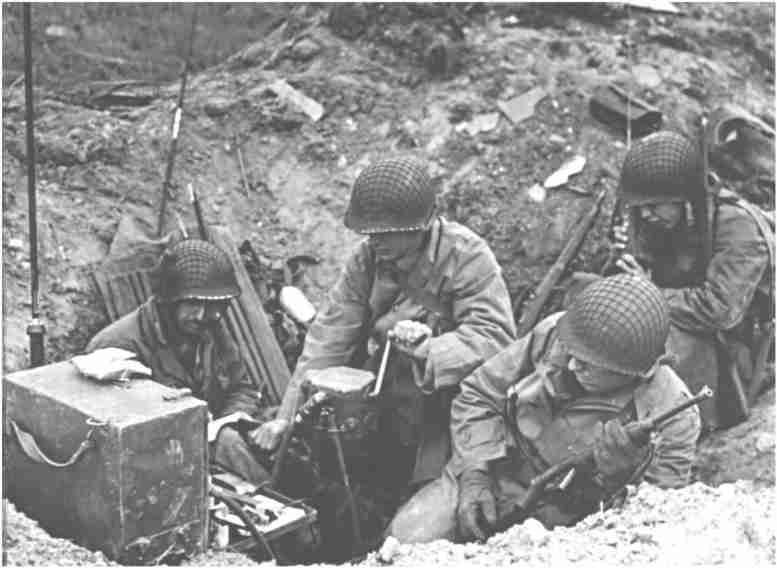

(Excerpts from J.D. Day at dawn) Gawne)
In Normandy, an NSFCP had three sections.
The observation section brought together an artillery officer, a sergeant and three radios.
The naval section included a Marine Officer, the Naval Gunfire Liaison Officer and three radios.
Section No. 3, motorized, programmed to join on day 6, included two jeep radios and their drivers.
Each of the first two sections of the NSFCP, with an artillery officer, was able to accomplish its mission, even if the other was not at work.
Each NSFCP accompanied (in principle) the unit's headquarters for which it operated and remained in radio contact with the vessel that worked with it. Each artillery support vessel adjusted its listening to the frequency of its NSFCP, as well as to a common band authorized for use by all emergency adjustment crews.
In Vierville, 3 NSFCP groups were disembarked:
NSFCP N°2 assigned to the 5th Rangers Battalion and HMS cruiser "Glasgow"
The NSFCP N°3 assigned to the 1st Battalion of the 116th Regiment and the USS destroyer "Mac Cook"
NSFCP No. 4 assigned to the 2nd Battalion of the 116th Regiment and to the USS destroyer "Carmick"
If a shot was requested, the naval unit would first fire a two-stroke salve to test its setting. The ship's radio sent the "splash" signal in plain language the second the blows were to explode. Due to the distance between the vessel and the target, the flight of the shells could be quite long and this indication allowed the NSFCP to distinguish between the naval shells and those fired by the surrounding artillery batteries.
Most of the NSFCPs have few results, as their materials are generally destroyed or put out of use by water. The SCR-284 radios were separated into several packages and the loss of a single one made the set unusable. Even the smaller radio SCR-609 was usually separated into 2 packages.
NSFCP Group 3 (destroyer "Mac Cook")
Assigned to the 1st Battalion of 116 Regiment, NSFCP 3 disembarked its three sections separately.
Captain John A. Easter, head of the observation section, accompanied a section of the B/116 Cie in front of the Vierville descent at 07:00. Only one of his five men got away safely.
Naval Liaison Section under Lieutenant (jg) Coit N. Coker, landed further east on Dog White with Cie C/116 at about 0740. Their LCVP ramp got stuck and they had to go overboard. Their SCR-609 radio was ready to broadcast around 8:30 a.m. and the team made a connection with the destroyer "McCook".
Coker was slightly injured on the beach but refused to be evacuated. Around noon, he stayed on the beach near Vierville, and was able to set the shot of the "Texas" and the "McCook" on the WN72 bunkers that were still defending the D1 beach exit. As a result of these salves, thirty defenders came out of the works, white flag in hand.
(the third section was the motorized echelon that landed much later and further towards Colleville)