An allied commando in the village of St-Laurent-sur-Mer,
on the night of 5 to 6 June 1944
________________________
This action has been hidden for many years. Only recently did the confrontation of various sources of information bring together some consistent data.
But many essential elements are missing, including:
- No personal testimony of the participants, probably bound by a common commitment not to disclose anything, commitment held until their death,
- The absence in the published archives of any information on the specific objectives of the action and any reports on its implementation.
Here are the data I have collected to date (Click on the image to see details)
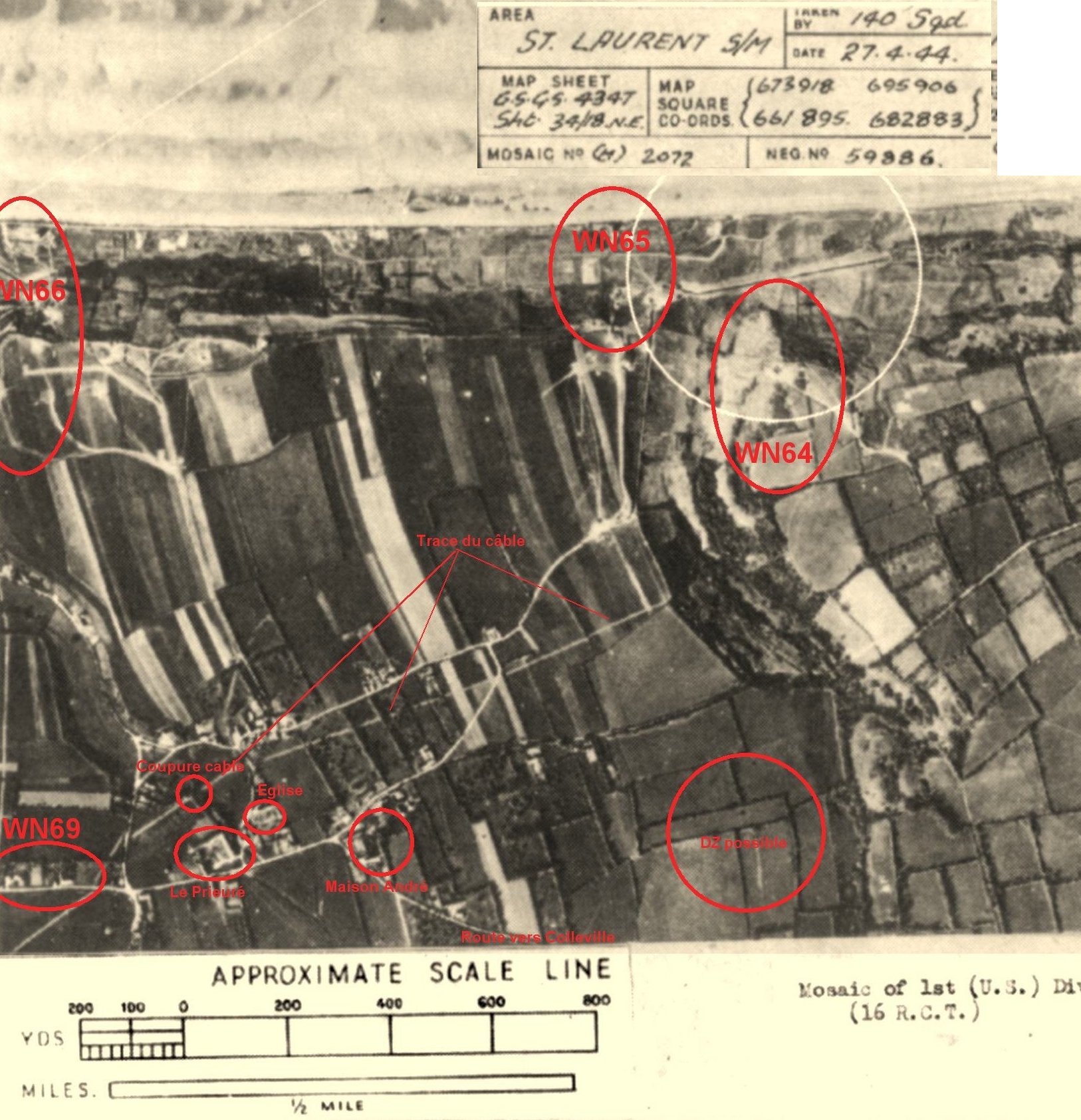
1 - Testimony of Edmond Scelles, 16 years old in 1944, who lived with his parents the farm of the Priory, next to the church of St-Laurent sur Mer. In a very long interview, he told about his days of June 6 and 7, 1944:
But at 05:00 on June 6, the cannonade began. But we didn't know it was landing. Since there was a hand in 42, we thought maybe it was a hand they were doing downstairs. We didn't know. It was ducking down the cliff, all along.
"Here we got up because it was so loud. My parents wanted to see.
"At about 07:00, we went to the stable to see the cows for milking them. There had already been American paratroopers: the wires of the German telephone that passed underground were cut, I am formal, I saw it. There was a small trench that had been made, and then they were cut. The cable was big, there was a small cable and a big cable. They were cut. So, there was an infiltration of Americans. I guess in the night, or in the morning, I can't say. I realized it when it was seven o'clock. Then we went back to the farm, it was always ducking down, there was nothing in the inside. We didn't see the Germans because they were hidden.
"There was a German who had stayed, for he kept the farm, I told him: "What is it? " He said to me, "no, great maneuvers, Tommies, Tommies! " Through the garden, the sea was very well seen, and I went to see him. Then I called my mother, and that's where we saw all those boats on the sea.
"All we had to do was wait."
2 - Another well-known testimony in the village is that of Albert André, a teenager, who lived in a village house, about 300 metres on the road leading to Colleville and Port-en-Bessin.
He told how he saw in the middle of the night from 5 to 6 June, several armed men, ambushed, silently killing the few German soldiers who were staying at his house and who were leaving the house one by one, equipped and armed.
Note: On 6 June 44, around 1 or 2am, the PC of the 352nd German Division (at the Molay-Littry), having learned the first parachute south of Carentan and beyond Caen, had all its units divided between Grandcamp and Arromanches put on general alert. In particular, all coastal units were ordered to immediately return to their combat stations. This procedure was well known to German troops through previous warnings and frequent exercises.
3 - At least 2 other residents of Saint-Laurent testified:
31 - Gaston Dupont also reportedly met some unknown and armed men in the middle of the night and served them coffee.
32 - Abbé Prempain, pastor of the parish of St-Laurent at the time, made the objrt of an entrefilet in a local publication, which I quote because it is precise, this priest was reliable and his account was disclosed shortly after the war.

4 - The search in the archives of the USA (OSS) and the French BCRA revealed a fairly complete list of operations carried out in France occupied in 1944, for the preparation of the Disembarkation, by the US secret services (OSS - Office of Strategic Service - and its London office), with the collaboration of the French service BCRA (Office Central de Recherche et d'Action) in London).
Thus within the framework of this plan called SUSSEX / PROUST, a parachute operation was carried out: the Driver / Ascain mission, summarily described in the files:
Organization: PROUST / OSS
Location: DZ (Dropping Zone or Paratrooper Drop Zone): Between Grandcamp and Saint-Laurent-sur-Mer.
Date: not specified in June 1944, some dates mentioned with uncertainties: 12 or 19 or 20 June 1944
Note: between June 12 and 20, the entire area between Grandcamp and St-Laurent was already entirely in the hands of the Americans who had passed Trevières and Isigny. The dates indicated, which are not credible for the ASCAIN mission, could then correspond to the debriefing of parachute agents after their return to London.
Participants:
12 French parachute officers, all officers or non-commissioned officers seconded to the OSS/G2 of the 1st US Army, whose names are as follows:
Captain Roger GUATTARY, alias Basco (Fr)
François BONAFOS, alias François Contet (Fr)
Louis CHEVALLIER, alias Louis Tournier (Fr)
Yves DUREMEYER, alias Dargeles (Fr)
Arthur LAURENT, alias Dupin (Fr)
Jean MASSON, alias Jean Moutier (Fr)
Norbert MEYER, alias Norbert Martin (Fr)
Fernand NOCETTI, alias Henri Bauge (Fr)
Yves POLLET, alias Georges Pocquet (Fr)
Albert POUPART, alias Viallat (Fr)
Henri StuBER, alias Aicard (Fr)
X, alias A. Beaupin (Fr)
The six United States OSS officers, the organizers of the mission in London, were:
Major R. LAMBERT
Major Liman Jr KIRKPATRICK
Lieutenant Harry R. RUSSEL
Lieutenant John MOWINCKEL
Sergeant JW ROBICHAUD
Sergeant WERTHEIMER
No order of operation, detailed purpose or report were attached to the published documents.
5 - The role of a group of French resistors present at Saint-Laurent sur Mer on June 6, 1944 was only recently revealed.
After the death of the last French participants of the commando, who had remained silent, some families revealed what they knew, at least partially, including the reality of this night parachute in St-Laurent the night before the landing on Omaha Beach
Precise parachute at night could not be done without a local reception team able to mark a DZ or dropping zone to be chosen in an isolated area of German positions close to the objective.
It was an existing resistance group on site that provided this assistance. They were part of the Alliance Network, founded in 1940 by Commander Loustanau-Lacau. One of its areas of action in the West (the "Ferme" sector) was entrusted to Jean Roger dit "Sainteny". (Sainteny had ties to Aignerville and Vierville where he owned a villa by the sea).
The Bessin sector was under the responsibility of Mr. Coulibeuf (known as "Bison Noir"), a teacher in Formigny, had a Rodriguez radio operator (known as "Pie"), a mailbox in Bayeux and several intelligence research groups, including one between Trévières and the beach of Vierville/St-Laurent.
This was the group formed by Désiré Lemière, Robert Boulard and Charles Olard (all three postal workers), Lucien Olard (a garage owner in Vierville), Albert Anne (a blacksmith in Asnières), and a few others. This team observed and transmitted information, taking advantage of the ease of movement of postal workers who could discuss with the inhabitants without attracting attention.
The Alliance network, like most resistance networks, has been hard hit by repression. Despite all the precautions, it was difficult to avoid infiltration by French agents working for the Germans. Radios were easily detected by radiogoniometry, forcing them to move constantly and at very rapid rates.
Several agents of this group were arrested by the Germans of counterintelligence on 5 May 1944 (most of them were shot by the Germans at Caen prison on the morning of 6 June 1944), but at the beginning of June the group was still able to provide, around midnight on the evening of 5 June, the reception of the commando of paratroopers on a DZ located south of the Ruquet valley. (see aerial photos)
The trace of their passage was marked by the ambush with the white weapon seen by Albert André near his house. Gunmen were seen by another resident of Saint-Laurent, Gaston Dupont. Finally at 7:00 a.m., Edmond Scelles noticed that the German telephone cable buried near his house "The Priory" had been severed in the night, but without knowing by whom.
One of the objectives of the Ascain mission was probably to cut this cable that connected the fortified WN 64 and 65 defending the Ruquet beach at WN 69, Kommandantur of Saint-Laurent and PC of all units (2 infantry companies and a group of rocket launchers Nebel Werfer) defending the Saint-Laurent / Les Moulins area (WN 66, 67, 68).
This cable was clearly visible in white in the aerial photos of the Allied aircraft, since it had been buried a few months before, the grass having not yet pushed back. The Alliance network's local information had probably shown the ease of locating and severing this important cable when it crossed the deep ravine between the church and the Prieuré farm. This probably prompted the OSS to attempt this harassment mission to disrupt the German defence.
The commando had thus acted in the middle of the night, 1.5 km from the beach where thousands of American soldiers would land at dawn. These soldiers were still, at this point in the middle of the night, on board their newly arrived troop transports and were laying their anchors quietly 10 nautical miles from the coast.
It is plausible to believe that this successful action could have facilitated, on the morning of June 6, the neutralization of the WN of the Ruquet, and then the landing at the same place around noon of the 2 regiments of American reinforcements. These landings were made without significant opposition from the German batteries camouflaged in the hedges of the interior, batteries directed by gunners observers placed on the coast, in each important WN, and connected by buried telephone wires.
Note: Another mission of this kind seems to have been carried out in Vierville at the same time, with American soldiers dressed in German uniforms, a mission that remained as secret as that of St-Laurent. To this day and to my knowledge, neither the American actors nor their families have broken the secret, we have only a few testimonies of French civilians, uncertain, fragmented and difficult to connect.