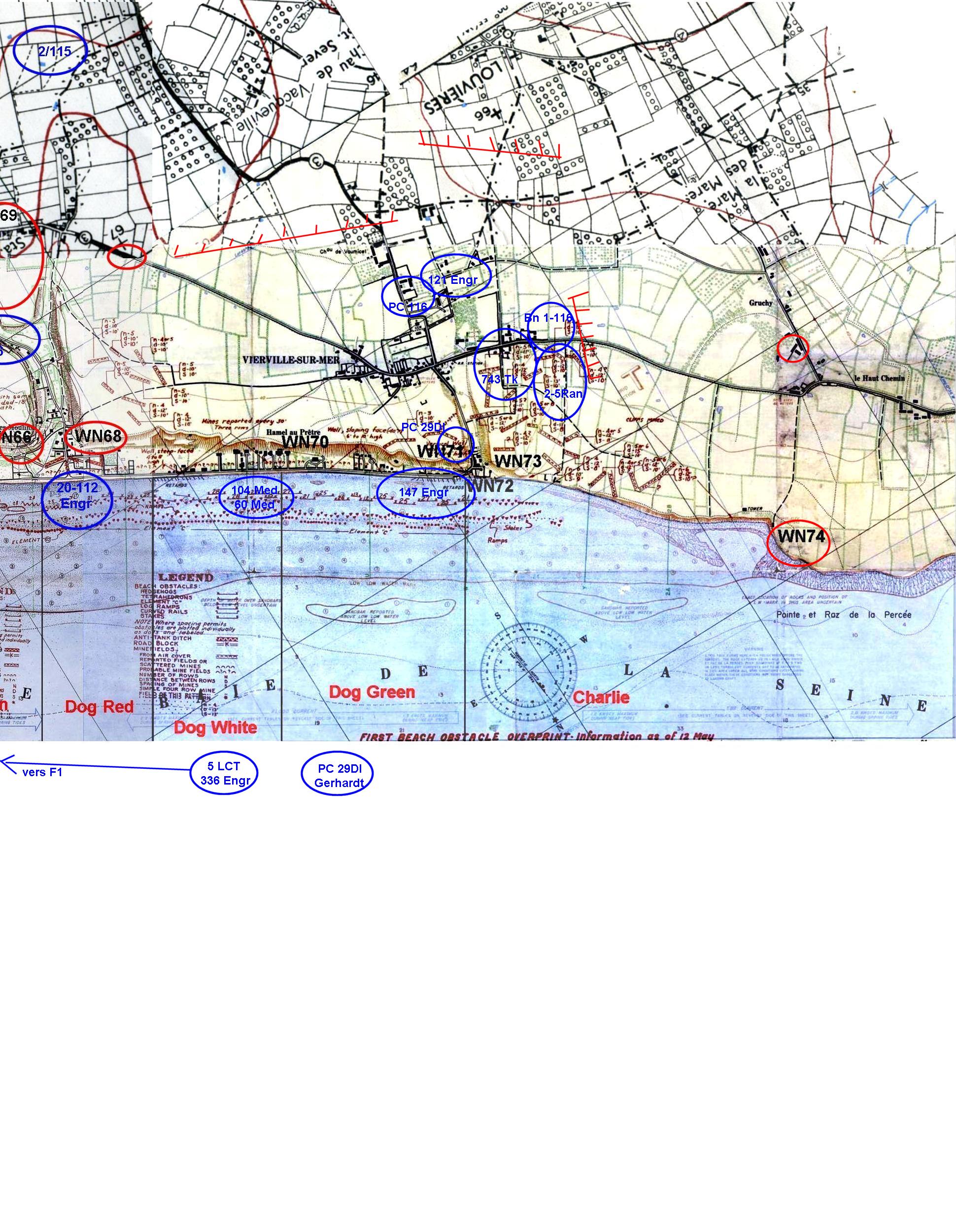
The Advanced PC of the 29th Division
settles in Vierville's career, around 18:00 on June 6th

(details) Gerhardt concerned aboard the USS destroyer "Maloy" on the morning of 6 June


(details) General Gerhardt leaves the "Maloy" to embark on a LCS (Landing Craft Support), a well-armed ship for the short-range support of the troops on shore. There are empty rocket sets and a 12.7mm double machine gun.
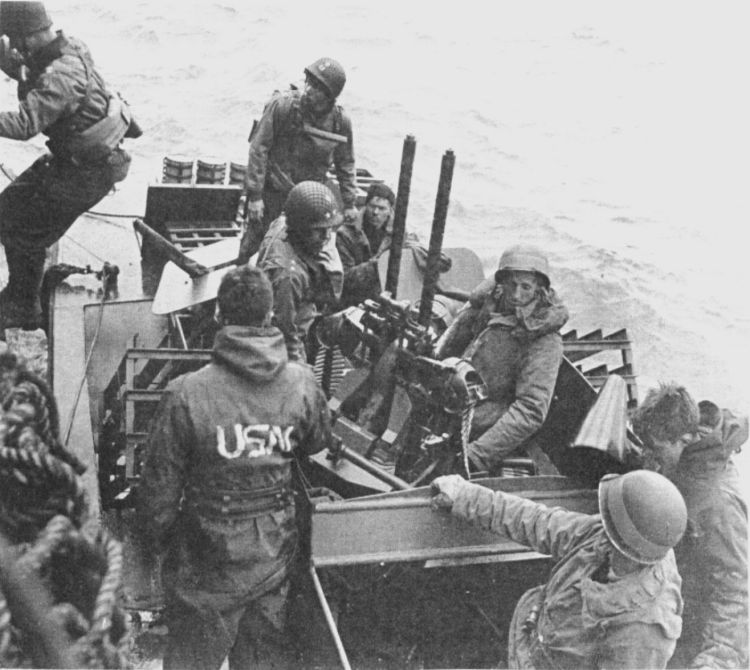
(details)
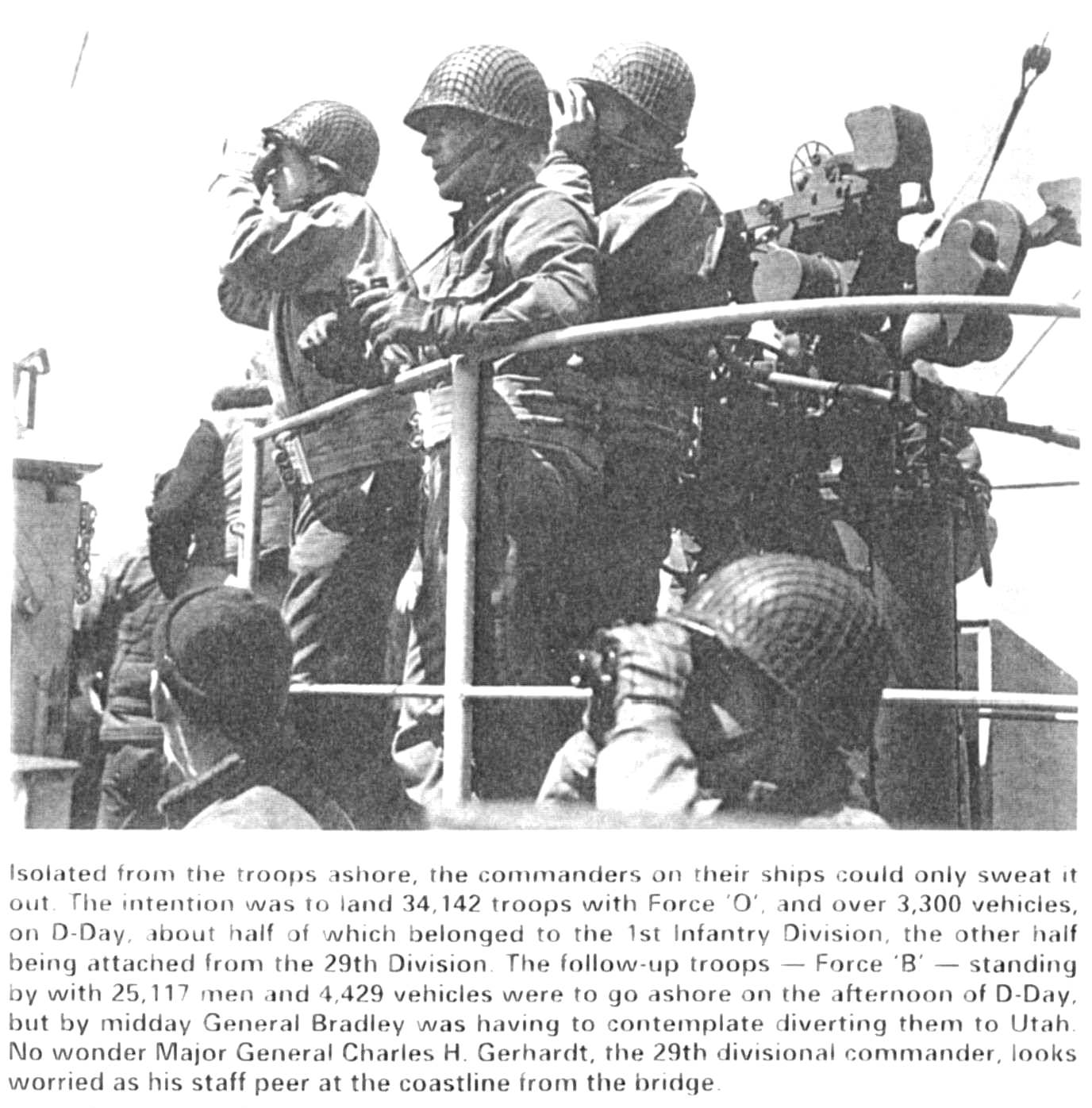



On 6 June General Gerhardt, CO. the 29th Division, did not yet exercise its command, because it was the 1st Division of General Huebner who was the head of all the US troops landed on 6 June, and in particular the 116th Regiment. Gerhardt was only supposed to take over his units on June 7th at 00:00.
Gerhardt and his forward staff were therefore not part of Force "O", but of Force "B", which was transported by 3 convoys scheduled to arrive in Omaha at 3.30 p.m. and 4.30 p.m. on 6 June and 6.00 p.m. on 7 June.
Force "B" began disembarking at 4.30 p.m. on 6 June.
Gerhardt, who was with Commodore Edgar (Cdt. Force "B"), aboard the USS escort destroyer "Maloy", left this destroyer at 5:05 p.m. and landed in the late afternoon in Vierville on "Dog White".
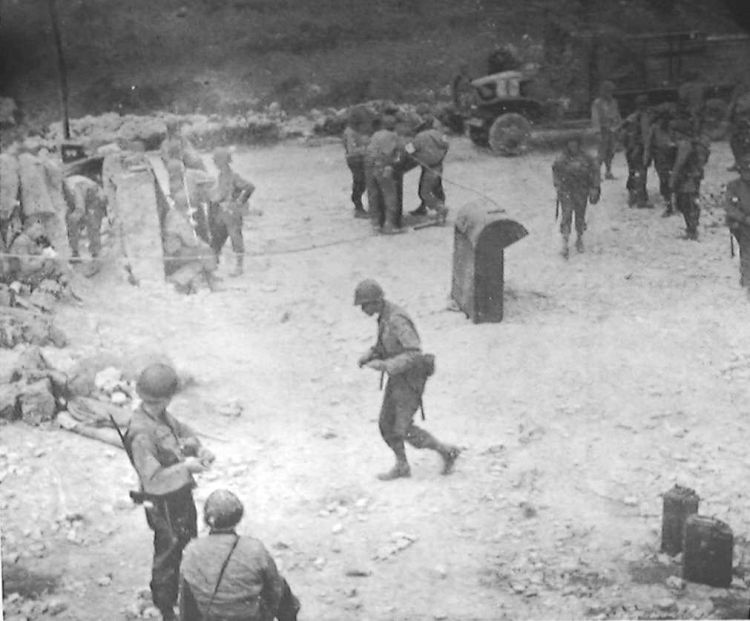
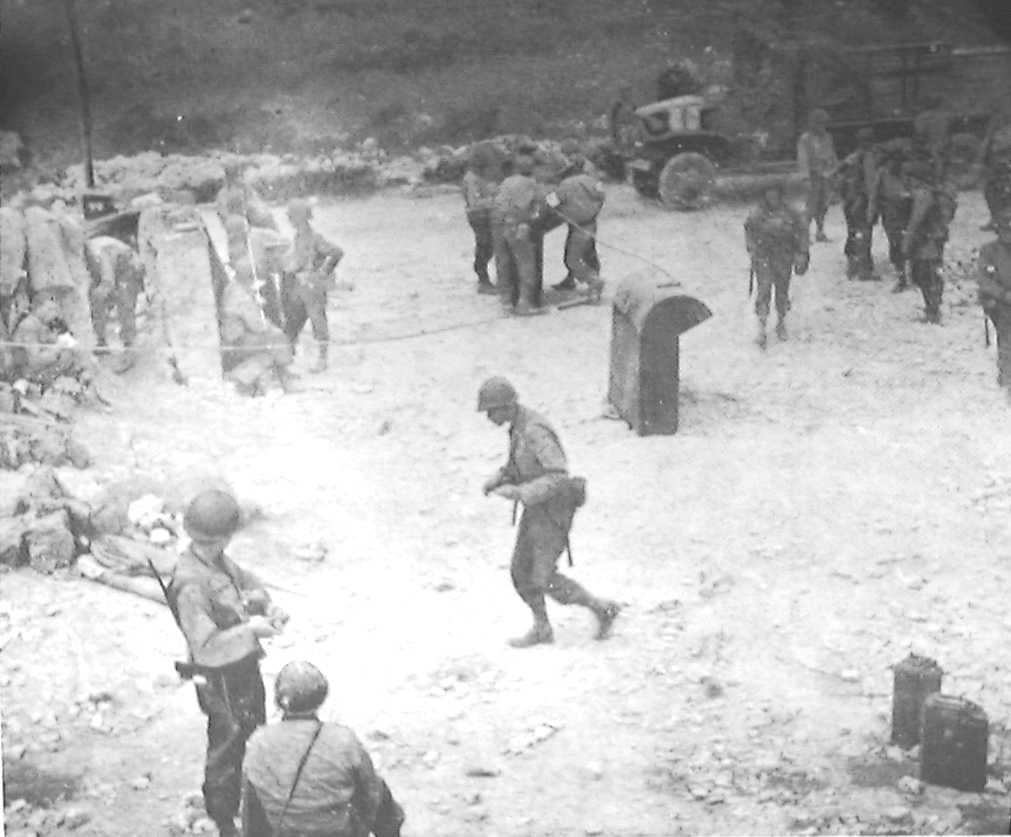
He was accompanied by his small staff, his deputy the general was not there and we did not know where he was. The 29th Division's advanced PC was installed immediately in the Vierville quarry on the east side of the descent, about 100m from the beach. (At 22:00, Major Johns, informed the 116th RCT PC that the division PC was located between Vierville and the beach exit, on the right of the road, in the Vierville quarry).
Lt Irwin, from G3 (operations) HQ 29th:
"There was no opposition when we went up the valley of Vierville and settled in the quarry. The forward step (General Cota and his small staff) was supposed to be on the other side of Vierville, but there was no communication with him. The provisional PC was therefore installed in the quarry. Radio contact was made at around 22:00 with the advanced stage, and Cota came to the quarry around 02:00 in the morning (7 June). The decision to return the advanced level (Cota) to the career was made, and was effective at dawn.
The advanced stage of the division, with General Cota, had been on land since 7:30 a.m., it had arrived in Vierville by the cliff at 11:00 a.m. with the CieC/116. He then descended the valley of Vierville at about 1 p.m.
Always with camp help, radio, and 3 bodyguards, making contact at the passage with the engineers on the beach and then with the 2nd and 3rd Bat/116 in St-Laurent, he had walked the road to the Ruquet. He had met General Gerow, Cdr. 5th Corps, at WN64, arriving at about 8:30 p.m. General Huebner, Cdr. 1st Division, arrived at 5:15 p.m., was at the top of the Ruquet Valley since 8:00 p.m.
He was able to gather information on the still uncertain situation and then returned to Vierville to make his direct report to General Gehrardt, who had the orders prepared for the next day.
Gerhardt, optimistic as usual, thought the situation well in hand. That night he did not tolerate any pessimism. The tragic stories of the day on the beach were quickly cancelled. Always concise, the general summarized the lessons of the day in 2 sentences:
"No disaster report should be allowed. They're still fake."
That night, however, no direct contact or patrolling existed between the career and the 1°Division's PC at the Ruquet, and radio links were impossible. (see below for Captain Ballard's mission to Saint-Laurent)
"In the career, General Gerhardt was sitting on a C rations fund, reviewing the cards and interviewing liaison officers."
"Tonton Charlie" could also see closely the soldiers of his division walking up the road to Vierville. Once, Gerhardt noticed a man eating an orange. The General jumped from his car, rushed into the surprised soldier and gave him a soap for throwing peels on the floor. The General was a maniac of cleanliness (his driver was sometimes forced to clean the jeep several times a day)."
Around 8:00 p.m., Captain L. Ballard, a liaison officer in Office S3 (Operations), therefore stationed in Vierville's quarry, was ordered to contact the 1°Division via St-Laurent.
Captain Ballard says:
"I asked for a volunteer to accompany me, and Sgt. Ted Josephs got up right away. After receiving a few quick instructions from the Chief of Staff, Sergeant Josephs and I started. I remember the sergeant was armed with a rifle, and I had a rifle and a gun. I carried in my combat jacket a map of our positions as we knew them at that time.
The night was very dark. Vierville, however, was lit by unextinguished fires. We went up the road to Vierville without noise and turned left at the crossing, in the centre of the village. It put us on the road to the east to Saint-Laurent. While we were about 400m behind the village boundary, a dog barked in a farm to the right. We flattened ourselves down, without moving, for a good time.
After the dog stopped barking, I called down sergeant Josephs and we continued, progressing half on the road and half in the ditch along her.
At the end of about 1/2 hour - it had to be almost 10 o'clock in the evening - we had travelled another 400m I think. Suddenly, I saw a man lying close by, touching him. Immediately he jumped and ran a few meters to the right. Immediately, I heard a sharp whistle and a robbery of bullets whistled in our direction.
Almost immediately three men came to me. I was lying on the side of the road. The roadway was dark, as the approaching men stood out on the sky. When I threw myself down, I had dropped the rifle, so instinctively I pulled out my gun and fired almost point-blank several times and quickly. Two men fell screaming. I don't know what happened to the third. It all happened very quickly. I went back to the right for a good distance and sheltered myself in a field where I regained my mind. I lost Sergeant Josephs and thought he was killed or captured.
I thought that I had met either a fortified point or a patrol, and that it was more important to report the enemy presence between us and the 1st Division than to try to join this 1st Division. I tried to return quickly to the career, where I found that the liaison had been established by the beach with elements of the 1°Division.
At dawn I detached a tank and left on the Saint-Laurent road to search for Sergeant Josephs. After about 1500m, the sergeant jumped out of a ditch and held me up. I've never been happier in my life. He said that he had killed him almost all night, not far from a group of Germans he heard talking about. The Germans had left just before dawn."