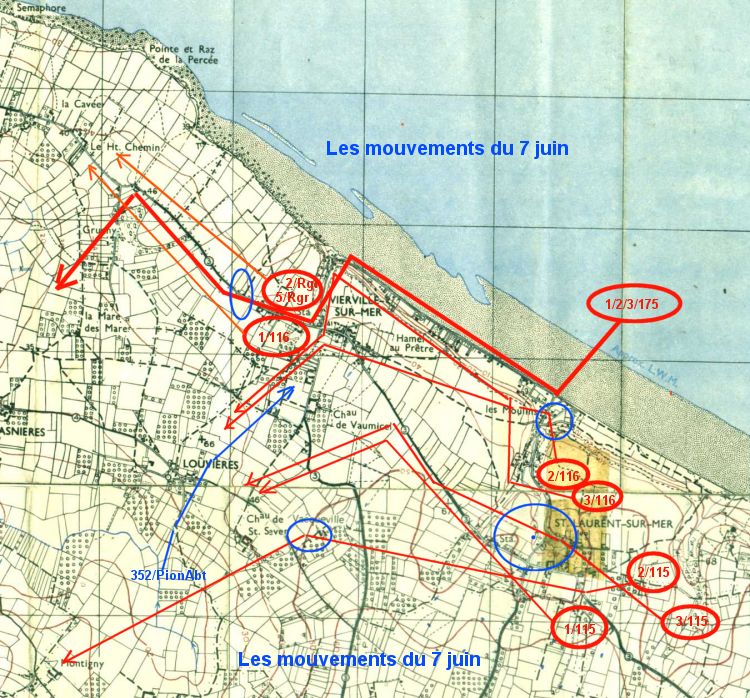
The movements of 7 June

German counterattack on 7 June
made American prisoners in Ormel
Early on the morning of June 7, a local counter-attack struck the B-Cie of 121°Bataillon du Génie bivouaquant near L'Ormel from the night before. The sappers were surprised when they woke up and driven out of their bivouacs, some (about 30 in all) captured. This incident caused great concern to the Americans in Vierville and they decided to clean the village immediately and fully defend it more effectively by returning 4 of 9 companies from Rangers who had just left for Pointe du Hoc
A description of their capture was made by Nurse Thomas R. Fitzgerald, while in prison camp. We can also read the Testimony of Sergeant Dube
"We were in our medical group -- Carter, Turner, Petricelli, Danniger and me. It was almost dark on D-Day night when we found our PC, about 1.5 km south of the village of Vierville. When we found the rest of the Company, we bivouaquéed in a field along a hedge outside the buildings. We had to dig individual holes, but I was too exhausted and lay down on the floor near the hedge. It was about midnight.
I heard a few shots fired not far that night. A man was killed by a bullet about 5 m from me, shortly before I went to bed to sleep. I was the last one along the hedge, near the corner of the field and the furthest off the road.
I don't remember anything until about 5:30 in the morning, when I thought there was a strong shooting. I was half asleep and thought I should get up in a few minutes, and eat, because I hadn't taken anything for 36 hours, but I fell asleep again until six. I was awakened by earth squeaking against my helmet and suddenly realized that machine gunshots were hitting the hedge land above me and on the ground in the vicinity....
Then I felt someone kicking my ass and not nice at all. I was bored at first, but when I turned around and started sitting down, there was a machine gun 30 cm from my face, with a German on top of me. I got up quickly and showed the Red Cross armband I was wearing and said I had no weapons. I tried to be as calm as possible and kept my hands above my head.
Since I was the first one to be caught, I had to wait for the rest of the section to be gathered along the hedge. A sergeant had a burst of machine gun in his body. Another guy I knew well, was a little too slow to get out of his hole and was hit in the head. Petricelli was one of the prisoners.
They took us out of the field with their hands on our heads, aligned us along the road and searched us. Then they made us walk on the road. After a while, the column was stopped by a German lieutenant. There was a long ditch 1m deep next to the road, on the right side, and he ordered us to go down there. Then he said something to a young German soldier who was with him, the soldier left and came back with a machine gun, the model with foldable butt. The lieutenant took the gun and started to go and come along the ditch, looking below us. We didn't know what he was going to do, but we were sure he was going to kill us. I don't remember how long he spent going and coming, but soon a civilian car arrived.
There was a higher rank officer in there, because he called the lieutenant. This one came to the attention of you and greeted. We didn't know what the officer said in the car, but he was yelling at the lieutenant. The car went back to Vierville. The lieutenant returned the machine gun to the soldier. We were brought out of the trench and we continued walking on the road.
We haven't come a long way because of our wounded and also because of artillery fire and attacks by allied fighter-bombers. We had to shelter once in an orchard more than 2 hours. We've been walking all day. All along the road we saw trucks and cars burned with dead Germans.
Every time we saw our planes we made great signs with everything we had to show that we were American prisoners. (The Germans did not object....) We were about 40. Around 10 a.m. this June 7th, we were put in a large dairy near Isigny. The French who worked there brought milk and cheese for us."